

You’ve seen algorithm bait even if you’ve never called it that. It’s that post that feels designed to make you pause, tap, argue, vote, or “wait… what?” your way into boosting it—because that’s how the feed decides what to show more of.
Sometimes it’s harmless (a clever hook, a genuinely good thread). Sometimes it’s a trap with a caption.
And yeah… I fall for it more than I’d like to admit.
Answer Box: algorithm bait, in plain English
- What it means: Content made to trigger the app’s ranking signals (watch time, comments, saves, shares), not just to inform or entertain.
- When people use the term: When a post feels “built for the algorithm” more than built for humans.
- Quick example: “Wait till the end 👀” + a 40-second video that could’ve been 8 seconds.
- Don’t do this: Don’t fake urgency or bait comments if you can’t deliver—people can smell it fast.
FAQ: the stuff people actually mean when they ask about algorithm bait
Is algorithm bait the same as clickbait?
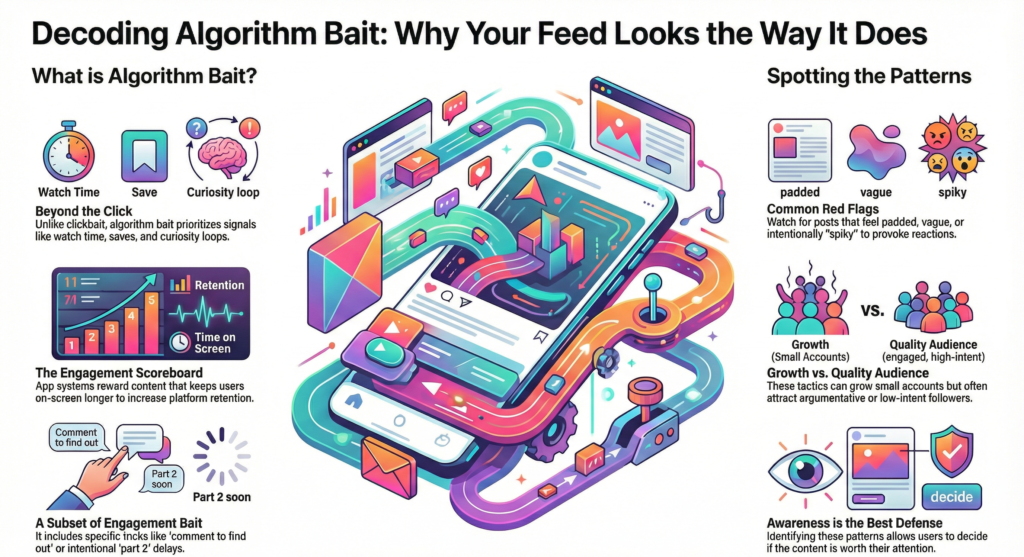
Not exactly. Clickbait is about the click. Algorithm bait is about the signals (watch time, comments, saves, shares) that keep the post circulating.
Is algorithm bait always bad?
No. A good hook isn’t a crime. It becomes gross when the “hook” is the whole product.
How can I tell if something is algorithm bait?
If the post feels padded, vague, emotionally spiky, or “comment to find out,” you’re probably looking at it.
Why do apps “reward” algorithm bait?
Because their systems prioritize what keeps people on-screen longer. Engagement is the scoreboard.
Do creators use algorithm bait on purpose?
A lot do—some strategically, some accidentally, some because it’s the only thing that seems to “work” that week.
Can algorithm bait help a small account grow?
Sometimes, yeah. But it can also attract the wrong audience (people who only show up to argue or demand “part 2”).
What’s the difference between “engagement bait” and algorithm bait?
Engagement bait is a subset (“comment YES if…”). Algorithm bait is broader: it includes watch-time tricks, saves, shares, and curiosity loops too.
How do I stop falling for it?
You don’t have to become a monk. You just need to notice the patterns—then decide if it’s worth your attention.
So what counts as algorithm bait? Real examples you’ve probably scrolled past
Let’s get specific, because “content optimized for the algorithm” is basically every post ever… unless we talk about how it’s optimized.
Example #1: The “answer in the comments” carousel
You’re on Instagram. It’s a carousel that says:
“The #1 habit ruining your productivity… (swipe)
(swipe) …you won’t believe this…
(swipe) …most people do it daily…
(swipe) Comment ‘ME’ and I’ll send the fix.”
No fix is ever sent. Or it’s a generic “wake up earlier” PDF.
That’s algorithm bait built to farm swipes + comments. And the UI makes it extra annoying because you’re already 7 slides deep and now you feel committed.
Example #2: The “wait till the end” video that could’ve been a screenshot
On TikTok (or any short-video feed, really):
Caption: “WAIT FOR IT 😳”
Video: 35 seconds of someone walking toward a box.
Last 2 seconds: the box contains… a normal cat.
This is algorithm bait for watch time. The goal isn’t the cat. The goal is you staying long enough for the system to go, “Oh! People watched. Show this to more people.”
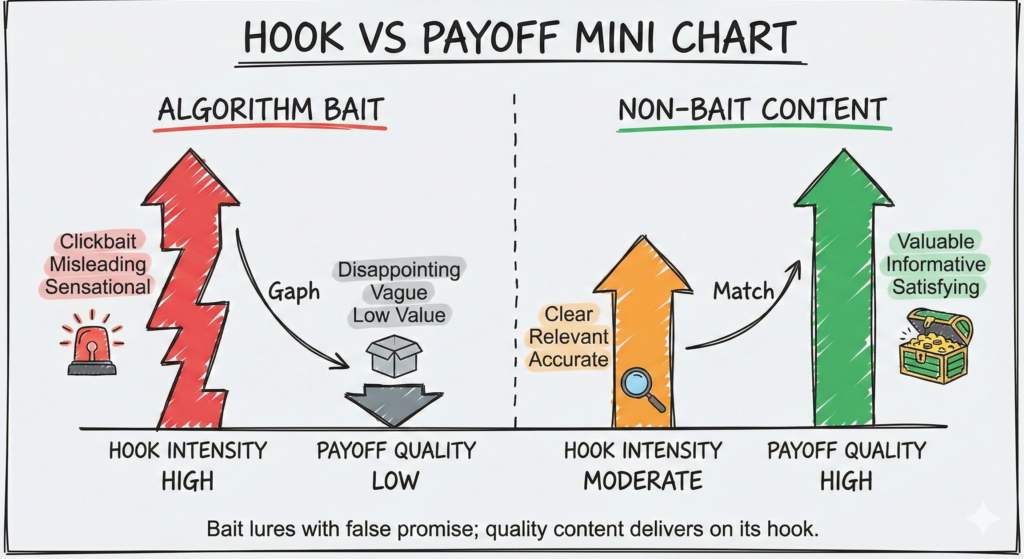
Quote-friendly truth: If the payoff is smaller than the buildup, it’s probably bait.
Example #3: The comment-war starter kit
You’re scrolling YouTube Shorts and someone posts:
“Hot take: pineapple on pizza is a red flag.”
Or: “If you do THIS at the gym, you’re disgusting.”
It’s not even about pineapple. It’s about rage comments and duets/stitches/replies. The post is basically tossing a match into a room full of dry paper and backing away.
Light humor moment: It’s like leaving a “FREE SAMPLES” sign outside a store when you’re not selling anything—just hoping people crowd the doorway.
A quick mini-story (because this is exactly how it gets you)
I’m on my phone “for two minutes.”
I see a video: “The one thing your friends aren’t telling you…”
I watch. Nothing happens.
The creator smiles like they’re about to reveal a secret.
I watch more. Still nothing.
Comments are yelling “PART 2???” like it’s a hostage situation.
I scroll to see if part 2 is linked. It’s not.
I check the profile. There are 47 parts.
And somehow I’m still there, annoyed… but there.
Confession: I ignored this for way too long because I thought algorithm bait meant “dumb people falling for dumb posts.” Nope. It’s just human attention doing human attention things.
Why algorithm bait works (even when you know it’s bait)
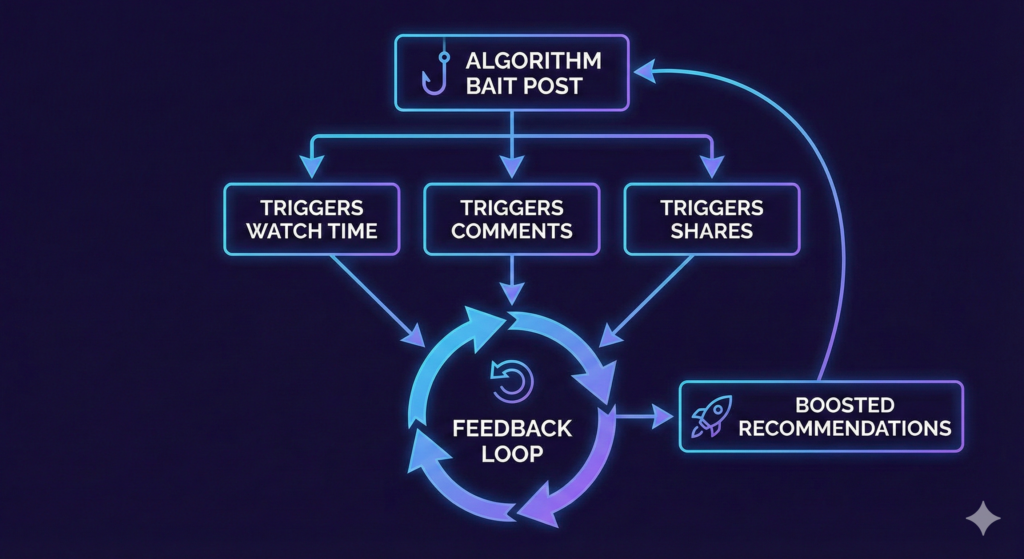
Here’s the part people don’t like to admit: the feeds aren’t “reading your mind.” They’re reading your behavior.
Not in a spooky way. In a very boring way.
- You pause = signal.
- You rewatch because you missed it = signal.
- You comment “wait what?” = signal.
- You share to a friend like “this is insane” = giant signal.
And the systems that recommend content openly talk about using these kinds of signals to personalize what you see. TikTok has a straightforward explainer of [how TikTok recommends videos #ForYou].
Instagram has also published a plain-language overview in [Instagram Ranking Explained].”
“YouTube breaks down its approach in [Algorithm-Based Recommendations on YouTube].” (YouTube)
Surprising detail people miss: “algorithm bait” isn’t always an insult. In some creator circles, it’s almost said with a shrug—like, “Yeah, I baited the algorithm a little.” It can be a confession, not an accusation. The vibe is less “you’re evil” and more “the game is the game.”
Algorithm bait isn’t magic—it’s just content shaped around the signals the feed can measure.
How to recognize algorithm bait without turning into a cynic
You don’t need to hate everything. You just need a few tells.
The “signal stack” checklist (quick, not dramatic)
If a post has two or more of these, I get suspicious:
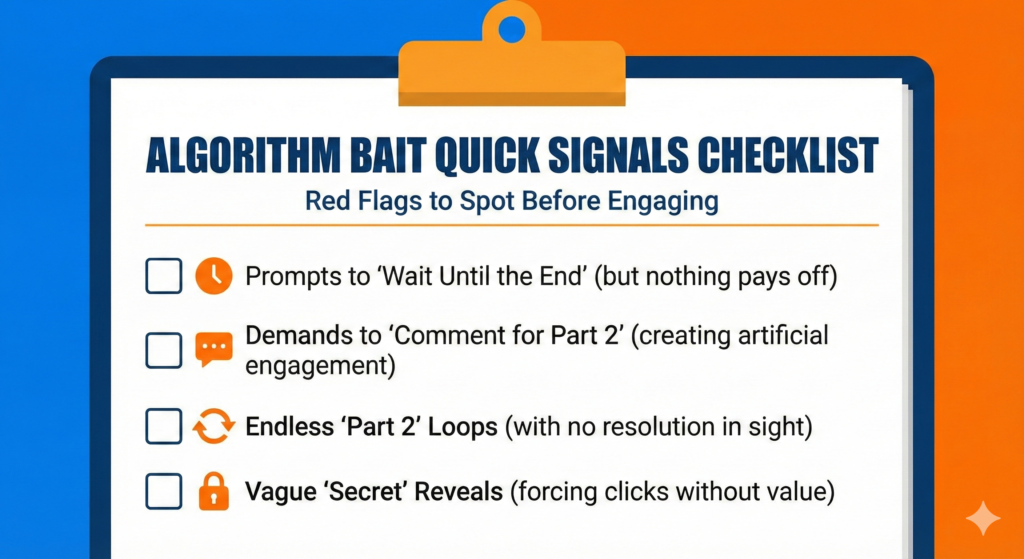
- The payoff is delayed on purpose (“wait for it,” “stay tuned,” “part 2 in comments”).
- The claim is huge, but the details are weirdly missing (“this will change your life” …how?).
- The caption demands an action that helps the post more than it helps you (“comment YES,” “tag 3 friends”).
- The creator keeps you looping (“watch again,” “you missed it,” “look closely”).
- The comments are the actual content (and the post is basically a doorway).
Quote-friendly line: If the post needs you to do homework to understand it, it’s probably bait.
The UI annoyance test
Ask yourself: Is the app interface being used as a lever?
Like:
- A cropped screenshot that forces you to tap to expand.
- Text placed exactly where the “more” button covers it.
- A “poll” style question that invites arguing.
- A carousel that’s intentionally paced like a cliffhanger.
You know what I mean? It’s not just “a good hook.” It’s “a hook built around the buttons.”
If you’re a creator: how to avoid being that person while still playing the game
Not everyone using algorithm bait is a villain twirling a mustache. Sometimes you’re just trying to make rent and the feed is moody.
Here are a few “not gross” ways to do it:
Deliver early, then earn the rest
Give the answer in the first 5–10 seconds (or first lines), then expand with detail. You keep watch time and you respect people.
If you’re trying to pick topics that actually have search demand, a keyword tool helps you stop guessing. […..]
Turn comments into usefulness, not begging
Instead of “comment YES,” try:
- “What would you add?”
- “What’s worked for you?”
- “If you want, drop your context and I’ll reply with ideas.”
That still invites discussion, but it doesn’t feel like a hostage note.
If you’re posting across platforms, a social scheduler can keep you consistent without panic-posting bait at midnight. […..]
Measure what’s real
A post can “win” the algorithm and still be a waste of your time if it attracts the wrong crowd.
An analytics dashboard helps you see what’s bringing followers vs. what’s bringing drive-by chaos. […..]
Don’t confuse algorithm bait with these cousins
This is where people talk past each other.
Algorithm bait vs. clickbait
- Clickbait: “You won’t believe what happened next” (the goal is the click).
- Algorithm bait: “Wait till the end / comment to get it / part 2” (the goal is measurable engagement signals).
Clickbait can happen off-platform (a headline). Algorithm bait is usually inside the platform’s interaction loops.
Algorithm bait vs. ragebait
- Ragebait is a flavor: it tries to make you mad on purpose.
- Ragebait is often algorithm bait because anger drives fast comments and shares.
Algorithm bait vs. trend-jacking
- Trend-jacking is riding a popular format/audio/topic.
- It can be totally fine. It turns into bait when the post is empty but uses the trend as a delivery truck for nothing.
Mistakes to avoid (aka: how to not sound cringe using this term)
Algorithm bait is one of those phrases that can make you sound… terminally online… if you use it wrong.
Common cringe moments
- Calling any hook “algorithm bait.” (Sometimes it’s just good writing.)
- Using it as a lazy insult: “This is algorithm bait” with zero explanation.
- Acting like you’re immune. (You’re not. I’m not. Nobody is.)
- Saying it under a post where the creator is clearly sharing something sincere. (Read the room.)
Tone mismatch warning: If you’re in a casual comment section, “algorithm bait” can sound like you’re trying to win a debate instead of having a conversation. If you must say it, be specific: “This feels stretched to boost watch time.”
A good hook isn’t bait. Bait is when the hook is the whole meal.
Tools that help (without turning you into a spreadsheet person)
Not “best tools.” Not “top picks.” Just… the kinds of tools that stop you from guessing.
If you’re trying to stop posting into the void
A trend tracker or social listening dashboard helps you see what people are actually reacting to, so you don’t rely on bait to get attention. […..]
If you’re trying to make content that survives longer than 24 hours
A keyword tool + basic SEO tool can help you build posts people search for (not just posts people accidentally argue with). […..]
If you’re trying to prove what’s working (instead of vibing)
An analytics dashboard helps you separate “viral because bait” from “growing because it’s valuable.” […..]
The point (and how to keep your brain)
Algorithm bait isn’t going away. The feeds reward what they can measure, and attention is the easiest thing to measure.
But you get to choose what you reward with your time.
If a post feels like it’s dragging you by the sleeve—“come on, just one more swipe, just one more comment”—you can back out. No guilt. No dramatic “digital detox era.” Just… nope.
Now go enjoy a piece of content that doesn’t demand your soul as payment.