

If you’ve been hearing situationship everywhere lately—TikTok captions, group chats, that one friend who texts “it’s complicated” like it’s a personality trait—same. It’s one of those words that sounds silly until you realize it describes something… painfully real.
Because a situationship isn’t just “dating.” It’s dating with relationship behavior… minus the part where anyone admits what’s going on.
And yeah, it can be fun. For a minute.
Then it starts to feel like you’re living inside a question mark.
Situationship, in plain English
A situationship is an in-between thing: you act like a couple (sometimes), you feel like a couple (sometimes), but nobody wants to put “relationship” on it. It’s not fully casual, not fully committed, and it’s usually a little unclear on purpose.
Answer Box (save this for later):
- A situationship = romantic/physical connection without clear labels or commitment.
- People use the word when it feels more than a fling but not an actual relationship.
- Example: you’re together every weekend, but they won’t call you their partner.
- Don’t do this: don’t keep “guessing the rules” for months like it’s a game.
If you have to guess what you are, that’s kind of the answer.
Here’s a surprising detail people don’t say out loud: “situationship” is often a soft warning label. Like, the person saying it usually already knows it’s messy… they’re just trying to make it sound casual so they don’t look “too invested.” (Been there. I ignored this for way too long.)
Also, tiny vibe note: people don’t usually say “my situationship” when they’re genuinely chill. They say it when they’re trying to act chill.
Situationship FAQ (what people actually mean when they ask)
Is a situationship the same as friends with benefits?
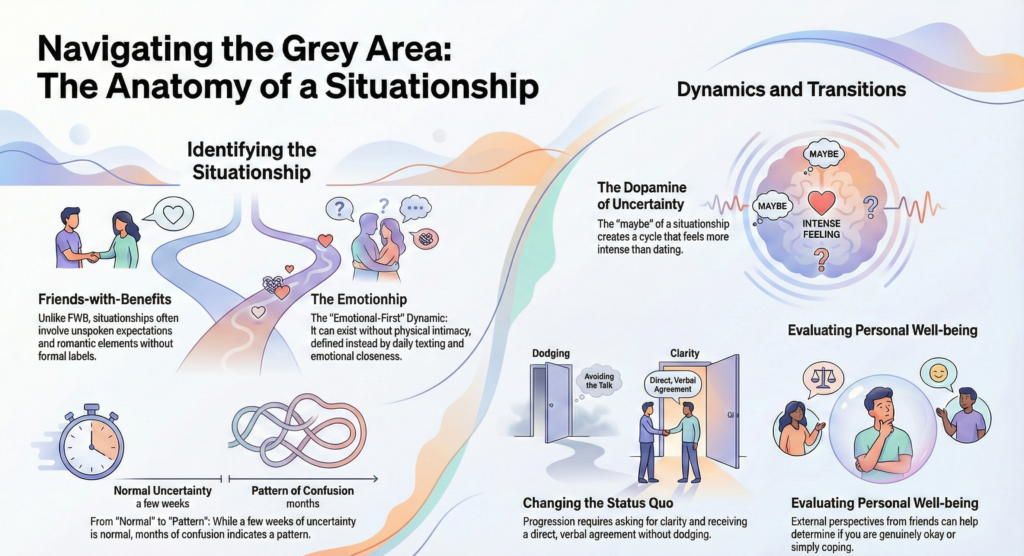
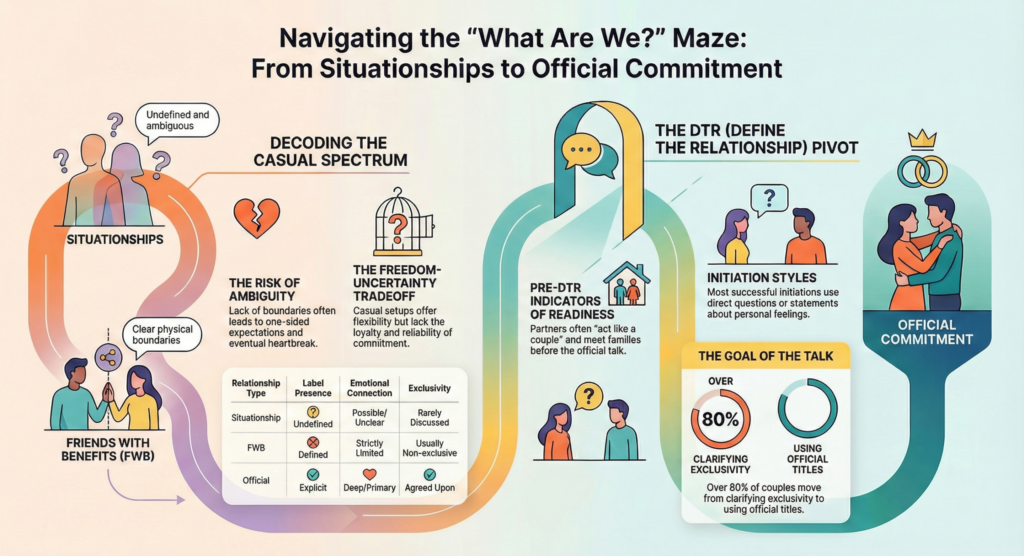
Not exactly. Friends-with-benefits is usually clearer: friends + hookup + no romance expectations (in theory). Situationships pretend there are no expectations while quietly collecting them.
Can a situationship turn into a relationship?
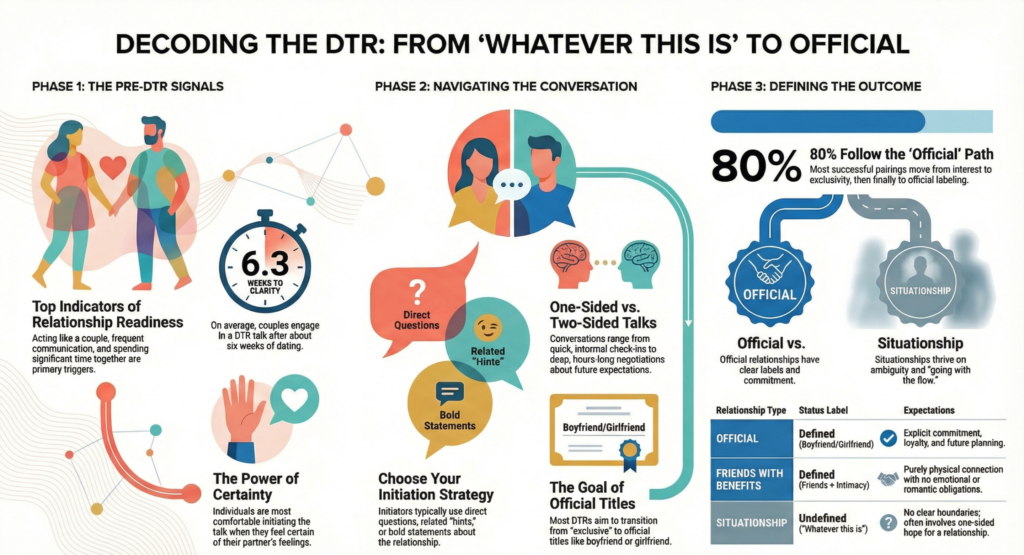
Sometimes. But it doesn’t “evolve” by magic. It changes when someone asks for clarity and the other person agrees—out loud—without dodging.
How long is “too long” for a situationship?
Opinion: if you’re asking this question, you’re already past the comfortable part. A few weeks of “we’re figuring it out” is normal. Months of confusion is a pattern.
Are situationships always toxic?
No. Some are genuinely mutual and temporary (new city, busy season, both people upfront). The problem is when only one person thinks it’s temporary.
Why does it feel more intense than dating?
Because uncertainty is a dopamine machine. The “maybe” keeps your brain checking for updates like it’s refreshing a feed.
What if I’m okay with it… but my friends think it’s bad?
Your friends aren’t living your life, but they might be noticing things you’re minimizing. Ask yourself: are you okay, or are you coping?
Is it a situationship if we don’t have sex?
It can be. Some situationships are emotional-first: daily texting, inside jokes, “goodnight 😴” messages… and still zero commitment.
How do I bring it up without sounding needy?
You don’t have to perform chillness. You can be direct and calm. (Scripts below.)
Signs you’re in a situationship (and not just casually dating)
Let’s make this practical. Here are signs that show up a lot:
You’re not “single,” but you’re also not… anything.
- You’ve met their friends… but only randomly, and it’s always “oh wow, didn’t expect you here.”
- You hang out at home, not out in the world.
- You know their coffee order, but you don’t know where you stand.
Concrete example #1 (the app/UI behavior one):
You’re basically dating in real life, but on the app they still show as “active now,” still updating their photos, still keeping the “Looking for: Not sure yet” vibe. And you’re trying not to notice… while absolutely noticing.
Concrete example #2 (the comment/text one):
They’ll like your Instagram Story within 30 seconds, reply with a fire emoji, call you “baby” at 1:12 a.m., then disappear for 18 hours like they got drafted into a secret mission.
Concrete example #3 (the real-life moment):
You’re at a party and someone says, “So is this your boyfriend/girlfriend?” and the person you’re with does that little laugh and goes, “Oh, we’re just vibing.” Meanwhile you’re standing there holding the same drink for ten minutes like a statue.
Quick checklist you can screenshot:
- You don’t have a label, and every label conversation gets deflected.
- The effort is inconsistent (big on Sunday, gone by Tuesday).
- Plans are last-minute, but the intimacy is high.
- You feel anxious more than you feel secure.
If you’re trying to get unstuck from the “what are we” loop, a simple boundary guide you can literally read off your screen helps. Not to be dramatic—just to have words ready when your brain goes blank. […..]
Why situationships happen (and why they’re weirdly sticky)
A situationship usually happens for one of three reasons:
- Two people want different things.
- At least one person is avoiding the grown-up conversation.
- The timing is messy (distance, life chaos, “not ready,” whatever).
And then it sticks because ambiguity has a hook. It’s like a shared Google Doc in “suggesting” mode—things are happening, but nothing is official. You know what I mean?
Here’s the mini-story version (tell me this isn’t familiar):
You meet. It’s easy.
You text every day, like, a lot.
They send memes that feel oddly intimate.
You start doing “normal couple” stuff—grocery runs, sweatpants, staying over.
Your friends ask, “So what is this?”
You say, “We’re just seeing where it goes.”
Then one night you post a photo together and they don’t like it.
They text you later though. At 12:47 a.m. Of course.
That’s the sticky part: it’s almost enough.
If you’re the kind of person who spirals after mixed signals (no shame), a journaling app can help you track patterns without rewriting history every time they send a sweet text. One note per day: what happened, how you felt, what you actually need. […..]
Situationship vs relationship (and two other terms people mix up)
Let’s not confuse the labels, because this is where people get stuck.
Situationship vs relationship
- Relationship: you can describe it in one sentence without flinching. There’s mutual agreement, consistency, and some form of commitment.
- Situationship: the “agreement” is mostly vibes. The consistency is… seasonal.
Situationship vs talking stage
Talking stage is earlier and lighter. It’s the “we’re getting to know each other” phase. Situationship is when you’re past that, but still pretending you’re not.
Situationship vs casual dating
Casual dating can be totally healthy if it’s honest. Situationships are casual on the surface, emotionally complicated underneath.
A quick gut-check question: If someone asked you what this is, would you answer confidently… or would you kind of laugh and change the subject?
If you want a second ‘yep, this is a real word’ reference that’s more formal, dictionary.cambridge.org is another easy check.”
Boundary scripts that don’t make you sound like a HR email
Okay. The “what are we” talk doesn’t have to be a courtroom drama.
You’re not asking for a wedding. You’re asking for clarity.
Try these scripts (copy/paste energy):
The calm and direct one
“Hey, I like spending time with you. I’m looking for something more defined than this. What are you looking for?”
The “I’m not mad, I just need info” one
“I’m noticing I’m starting to get attached, and I don’t want to keep guessing. Are you open to this becoming a relationship, or do you want to keep it casual?”
The boundary-without-blame one
“I’m not comfortable doing relationship things without relationship clarity. If we’re keeping it casual, I need us to act casual.”
The exit-ramp one (gentle but real)
“I’m into you, but this setup isn’t working for me. If you’re not on the same page, I’m going to step back.”
Clarity isn’t needy. It’s basic.
If you’re trying to meet people who actually want the same kind of thing (instead of playing romantic roulette), a dating app that lets you filter by intentions/relationship goals can save you time. […..]
And if this whole topic hits a nerve (or keeps hitting the same nerve), talking it out with a licensed therapist—especially someone who understands boundaries and attachment—can help you stop repeating the same dynamic with a different face. Therapy platforms make it a lot easier to start without overthinking it. […..]
Mistakes to avoid (aka how to not sound cringe about it)
A few common misuses and facepalm moments:
- Using “situationship” as a cute nickname for being treated badly.
Calling it slang doesn’t make it less painful. If it’s hurting you, it’s not “just a situationship,” it’s a problem. - Dropping the word too early.
If you’ve hung out twice, it’s not a situationship. It’s just… dating. (Or talking. Or flirting. Or whatever.) - Announcing it like a flex.
“I’m in my situationship era 😌” is funny online. In real life, it can be a way of avoiding the uncomfortable truth. - Matching their ambiguity harder than they do.
You start acting colder to seem chill, they get even looser, and suddenly you’re both pretending you don’t care while caring a lot.
And a tone mismatch to watch for: calling someone your “situationship” to their face can land weird. It’s a behind-the-scenes label, not a cute pet name.
One more direct question: Are you enjoying this, or are you enduring it? Different answer, different next step.
And if you take nothing else from this: a situationship is only “chill” when it’s clear. Otherwise it’s just confusing with better lighting.