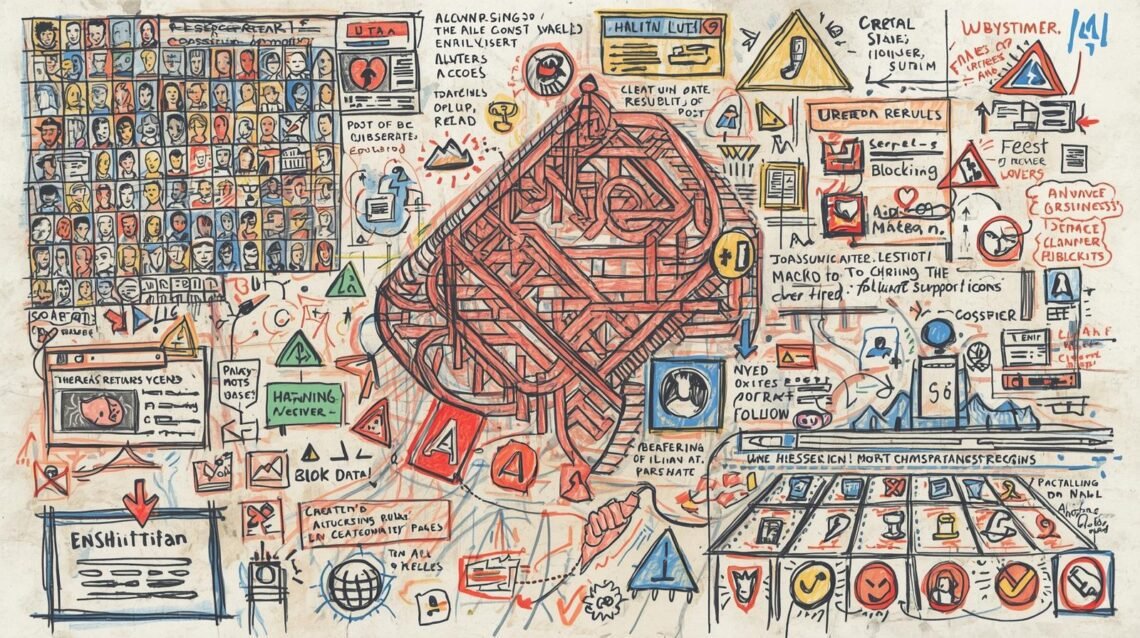
I keep seeing people ask What is Enshittification like it’s some new tech diagnosis. And honestly… it kind of is. You don’t need a computer science degree to feel it. You just open an app you used to like, and suddenly it’s louder, slower, pushier, and weirdly determined to make you tap the wrong thing.
If you’ve ever thought, “Why is everything nagging me now?” — yep. That’s the vibe.
One quick warning though: this word is spicy. Use it with friends. Maybe don’t drop it in a work email to your boss. (Unless your boss is cool. And/or also tired.)
What is enshittification, in plain human language?
Enshittification is when a platform starts out genuinely good… then gradually makes the experience worse on purpose because squeezing money out of you (and everyone else) becomes the main goal.
Not “oops, a bug.” Not “they redesigned it.” It’s the slow conversion of a nice product into a money vacuum with a UI.
Enshittification is the moment you realize the annoyance isn’t accidental — it’s the business plan.
Answer Box (steal this for your group chat)
- It means a platform gets worse over time because profit starts mattering more than users.
- People use it when an app adds more ads, more paywalls, more “suggested” junk, and more friction.
- Example: your feed turns into “recommended” posts + ads, and your actual friends vanish into the basement.
- Don’t do this: don’t call every annoying update “enshittification.” Sometimes it’s just a bad redesign (still painful, different crime).
Quick FAQ (so you don’t sound cringe using it)
Is enshittification the same as “too many ads”?
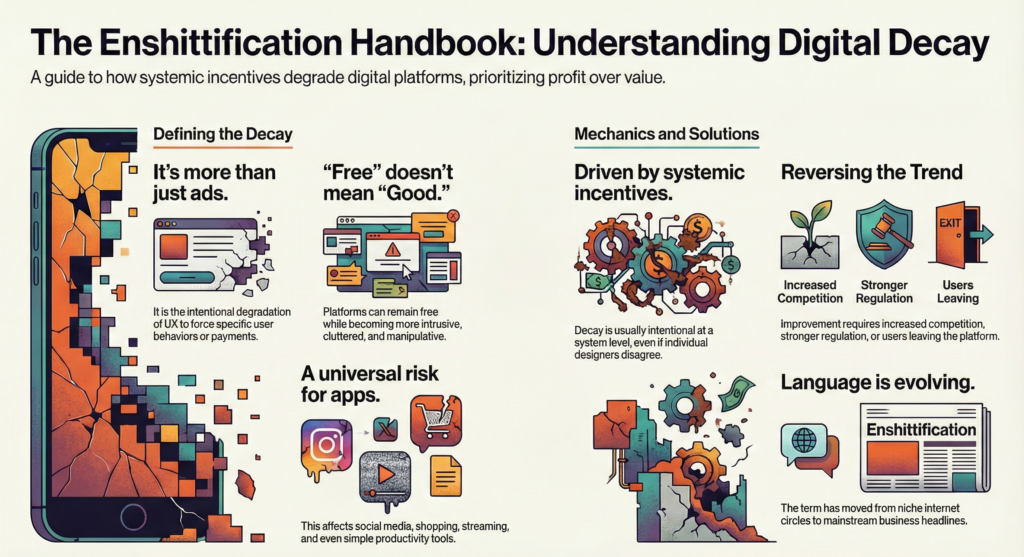
Ads can be part of it, but the bigger point is the experience is being degraded to push you toward paying, clicking, or staying longer than you wanted.
Who even says this word?
Mostly internet/tech policy people, indie creators, and Very Online folks. Surprising twist: it’s also popped up in mainstream headlines and “serious” business contexts, which is hilarious given the word choice.
Can a product be enshittified without raising prices?
Oh yeah. It can stay “free” while becoming more intrusive, more manipulative, and more cluttered.
Is it always intentional?
Usually it’s intentional at the system level. Individual designers might hate it. But the incentives win.
Is it only for social media?
Nope. Shopping, streaming, productivity tools, even “simple” apps can slide.
What’s the opposite of enshittification?
People sometimes joke about “disenshittification” — basically, fixing the incentives so the product has to be good again. (Competition helps. Regulation helps. Users leaving helps. Yes, I know… easier said than done.)
How do you use it in a sentence without sounding like a walking thinkpiece?
Try: “This app’s enshittification needs to be studied.”
Or: “It used to be fun. Now it’s… enshittified.”
Is “enshittify” a real verb?
Sadly, yes. Language is alive and it’s doing chaos.
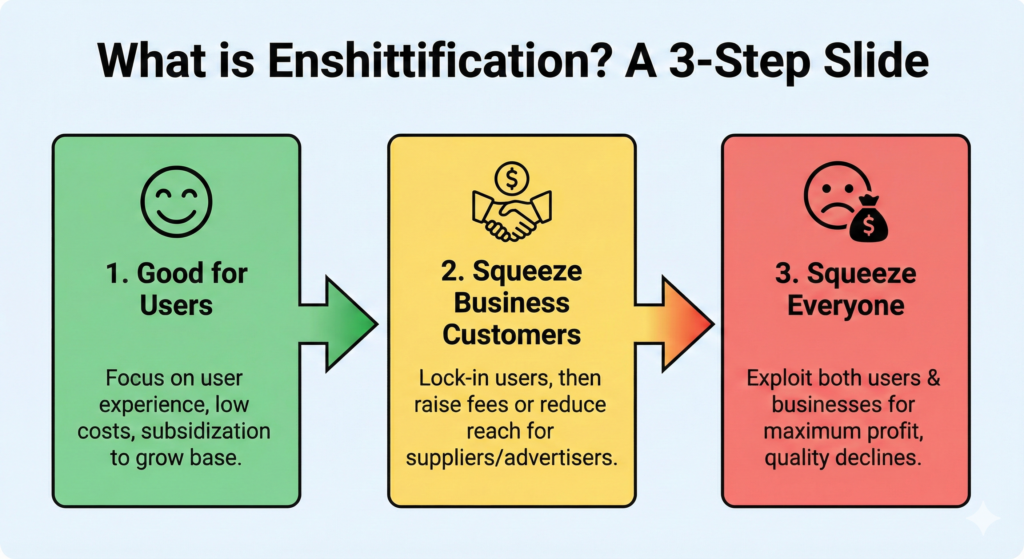
How it happens (the 3-step slide people keep talking about)
This term got popular thanks to Cory Doctorow (sci-fi writer + internet-rights guy who’s very good at naming ugly patterns). He describes a pretty consistent arc: platforms behave, then they don’t.
Here’s the simple version:
- Be amazing to users.
You’re the priority. The app is clean. The experience is smooth. Your friends actually show up in your feed. - Shift the good stuff toward business customers.
Creators, advertisers, sellers — whoever pays — start getting the best treatment. Your experience gets a tiny bit worse, but you stay because you’re already there. - Squeeze everyone.
Users get more friction. Businesses get worse deals. The platform keeps the value for itself. Everyone feels vaguely trapped.
One metaphor (and only one): it’s like a public park that starts replacing benches with billboards… then fences off the shade… then charges admission… and somehow you still keep going because all your friends are already inside.
Real examples (the “oh wow, that’s exactly it” kind)
Let’s make this concrete, because “platform decay” sounds like a fancy way to say “sad vibes.”
Example 1: The feed that stopped being for you
You open a social app to see what your friends posted.
Instead, the top of your screen is:
- “Suggested for you”
- a viral clip from someone you don’t follow
- an ad that looks like a post
- a “people you may know” carousel
- maybe your friend’s update, somewhere down there, waving faintly
And the really annoying part? If you interact with one random suggested post (even by accident), you’ve basically trained the app to feed you more of that forever. Have you noticed how hard it is to “undo” that? Yeah.
Example 2: “Just one more step” subscription pressure
Streaming app: “Watch now.”
You tap.
Suddenly it’s: “Start your free trial.”
You back out.
Now it’s: “Limited-time offer.”
You close it.
Next day: “We noticed you didn’t finish setting up your trial.”
It’s not just the paywall. It’s the nagging. The constant little “are you sure?” popups that treat your attention like a piñata.
Example 3: The ad-blocker arms race
A lot of people have noticed certain platforms getting more aggressive about pushing ads — and pushing back on ad blockers — because ads are the money engine. Doctorow even points to tactics like tougher anti-adblock moves as part of the wider trend.
And no, I’m not saying ads are evil. I’m saying there’s a difference between “this keeps the lights on” and “this app is now a slot machine with extra steps.”
If the app starts feeling like it’s trying to trick you, that’s not your imagination — it’s a phase.
A tiny story (because you’ve lived this)
Last week I opened an app to check one thing. One.
A message from a friend.
But the app opened on a full-screen “recommended” video instead.
I swiped away. Another video.
Then a pop-up: “Turn on notifications so you don’t miss anything!”
I tapped “Not now” (politely), and it asked again… with different wording.
Finally I found the message… and the reply box was half-covered by a “try our new feature” banner.
I sent “lol” out of pure exhaustion.
Tell me that isn’t modern life.
The surprising detail people miss about this word
Enshittification isn’t just “things get worse.” It’s a specific accusation: the decline is tied to lock-in.
That’s why the word gets used most when:
- you can’t easily move your stuff somewhere else (messages, followers, playlists, purchases)
- the alternative apps feel empty because everyone’s still on the big one
- leaving means losing history, connections, and momentum
So when someone says “enshittification,” they’re often saying:
“This isn’t a random decline. It’s what happens when you’re stuck.”
Also: I used to think I was just getting grumpy online. Turns out… nope. It’s a pattern.
Don’t confuse enshittification with these cousins
This is where people get sloppy (and then the word loses its bite).
Enshittification vs. dark patterns
- Dark patterns are specific tricks in design: making “Cancel” hard to find, using confusing buttons, guilt-tripping popups.
- Enshittification is the bigger arc: the whole experience sliding downhill because profit extraction becomes the priority.
Enshittification vs. feature creep
- Feature creep is when an app adds too much stuff and gets messy.
- Enshittification is when the mess is strategic — designed to funnel you into ads, upgrades, or endless engagement.
Enshittification vs. paywalling
- Paywalls can be fair (people need to get paid).
- Enshittification is when the free version gets deliberately worse to force the upgrade, and the upgrade gets steadily worse too.
Mistakes to avoid (aka how to not be That Person)
Here are the most common misfires:
- Calling every update enshittification.
If an app simply changed its font and you hate it, that’s not automatically the big E-word. - Using it as a synonym for “I’m bored.”
If you’re just over a trend, say that. Enshittification is about incentives and degradation. - Dropping it in the wrong room.
In a casual chat: fine.
In a customer support email: maybe chill.
In a comment under a wholesome pet video: please don’t. (Or do, but know you’re choosing violence.) - Saying it like you invented it.
Just say, “People call this enshittification,” and move on.
How to protect yourself (without becoming a full-time privacy monk)
You can’t personally fix the internet. (If you can, congrats, please call me.)
But you can reduce how much the enshittified stuff messes with your day.
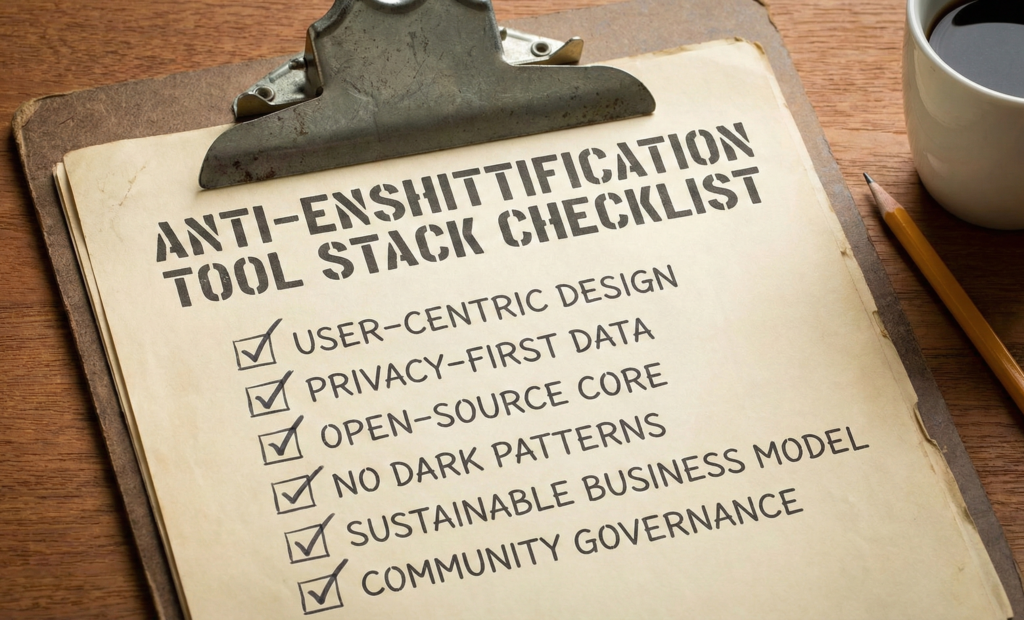
Here are tool-types that help, without me doing the gross “TOP 10 BEST” thing:
If you want less junk in your browsing…
A solid ad blocker / tracker blocker can cut down the noise and the weird “follow you everywhere” ads. <…..>
If you’re tired of being tracked across sites…
A privacy-focused browser (or browser settings/extensions that block third-party tracking) can make the web feel less like it’s reading over your shoulder. <…..>
If you keep resetting passwords (or reusing them… no judgment)
A password manager helps you use strong, unique passwords without memorizing 47 variations of “Summer2026!!!”. <…..>
If you’re signing up for stuff you don’t fully trust
Email aliases (aka “hide my real email” tools) are great for newsletters, one-time downloads, and that site you only need once. <…..>
A small practical move that’s underrated
Turn off non-essential notifications. Seriously.
A lot of enshittification runs on making you come back reactively. If your phone stops begging, your brain gets quieter.
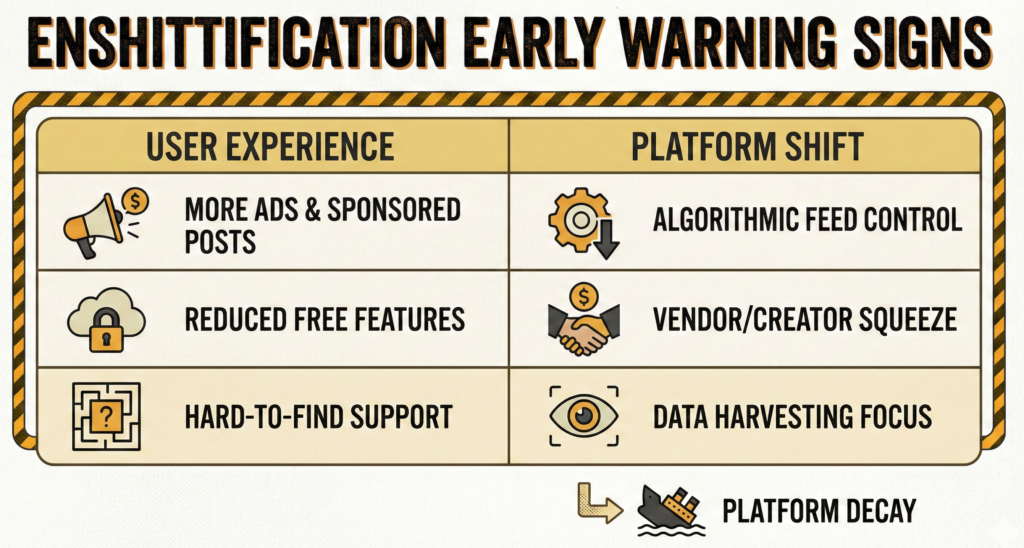
“Signs your app is being enshittified” (quick check)
You don’t need to be 100% sure. This is more like weather forecasting.
- More “recommended” content than content you asked for
- Ads that blend into posts
- Features moved behind paywalls that used to be normal
- More friction to do basic things (search, sort, save, message)
- Constant prompts to enable notifications, contacts, location, everything
- “For you” everywhere, even when you didn’t ask
Where you’ll see the word (and when it hits hardest)
People usually say “enshittification” when:
- an app they loved becomes annoying in the same specific ways as other apps
- creators complain they’re getting paid less while the platform gets greedier
- users feel trapped because moving platforms means losing everything
Also, the word got a weird boost from “word of the year” attention — which is how you end up with your aunt asking what it means at dinner. Amazing timeline.
And if you take nothing else from this: the feeling you have when an app turns annoying isn’t you being dramatic. It’s you noticing the pattern early — which is honestly a useful skill now.