
Rage Bait Is Everywhere—and Yeah, It’s On Purpose
I keep seeing rage bait in places that used to be… chill-ish. A cooking video. A relationship clip. A random “life advice” thread. Suddenly I’m annoyed, hovering over the comment box like I’m about to deliver a courtroom closing statement. Sound familiar?
Rage bait is basically content that tries to make you mad on purpose—because your anger is engagement, and engagement is oxygen online.
I used to think I was “too smart to fall for it.” I ignored this for way too long. Then I noticed my own thumb doing that angry-scroll thing at 11:47 p.m., and I was like… oh. It’s me. I’m the lab rat.
Rage bait, in plain English (so you can move on with your life)
Rage bait is a post, video, or comment designed to irritate you just enough that you react—usually by arguing, quote-posting, stitching, duetting, sharing “can you believe this??”, or dumping a paragraph in the replies.
It’s the digital equivalent of someone loudly dropping a tray in a quiet café so everyone looks up, annoyed… and then they pretend it was an accident.
Answer Box:
- What it means: content made to spark anger for clicks, comments, and shares.
- When people use it: when someone wants fast engagement (or wants to “feed the algorithm”).
- One example: a video that confidently “explains” something wrong, then pins the nastiest reply to keep the fight going.
- Don’t do this: don’t reward it with a 12-tweet thread unless you want more of it in your feed.
If a post makes you feel like you have to correct it, that’s the hook.
Quick FAQ people actually Google
Is rage bait the same as trolling?
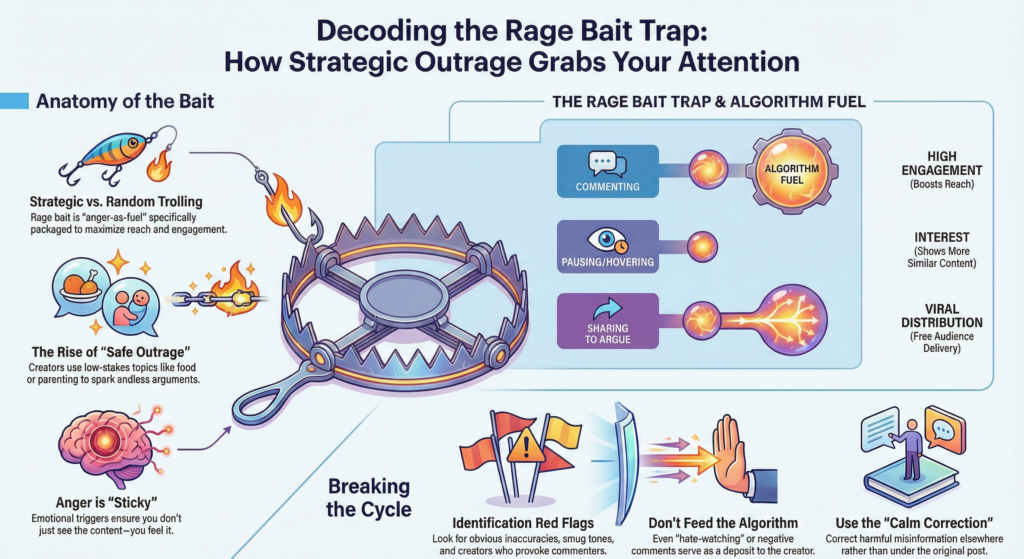
Not exactly. Trolling is often about messing with people for the reaction. Rage bait is usually more… strategic. It’s anger-as-fuel, packaged for reach.
Why does rage bait work so well?
Because anger is sticky. You don’t just see it—you feel it. And feelings make you tap.
Is rage bait always political?
Nope. And this is the part people weirdly miss: a lot of rage bait is “safe outrage.” Food takes. Parenting takes. Gym takes. “I wash my chicken with soap.” Stuff people can argue about forever without getting the post removed.
How can I tell if something is rage bait or just a bad take?
Look for patterns: obvious inaccuracies, smug tone, “everyone is too soft,” and a comment section that’s basically a cage match—plus the creator keeps tossing fresh chairs into the ring.
Do creators do this on purpose?
Sometimes, yes. Sometimes it starts as an accident and they realize the angry version gets 10x the comments… and then it becomes their whole personality.
What does “don’t feed the rage bait” mean?
It means don’t reward it with attention. Attention is the payment. Even “This is dangerous misinformation!!!” can still be a deposit.
Can rage bait be used on me even if I don’t comment?
Yeah. Watching, rewinding, hovering, sharing to a friend with “LOOK AT THIS,” even pausing too long—those signals can still teach your feed what to show you next. (Estimate/opinion, but it matches how modern feeds generally learn from behavior.)
Is it ever worth responding?
Sometimes. If it’s hurting someone or spreading something harmful, a calm correction elsewhere (not under the original post) can be smarter. Rage bait posts love “free audience delivery.”
How creators use rage bait (and the sneaky stuff people don’t notice)
Here’s what it looks like in the wild:
Example 1: The “confidently wrong” explainer
A video pops up: big caption text like “YOU’VE BEEN BRUSHING YOUR TEETH WRONG YOUR WHOLE LIFE.” The person says something wildly off, with total confidence. The comments explode. The creator replies to the angriest comment with “y’all are so triggered 😭” and pins it.
That pin is basically a little fireplace log. Keeps the heat going.
Example 2: The “two buttons” comment section trick
You open the comments and it’s sorted by “Top” or “Most relevant,” which often means the spiciest fighting gets pushed up. You see the nastiest reply first. Now you’re mad before you even know what happened. (And yes, some apps make it annoyingly hard to sort by newest, you know what I mean?)
Example 3: The “rage sandwich” carousel
Slide 1: normal statement. Slide 2: extreme statement. Slide 3: “Agree?” Slide 4: “If you’re offended, that’s your problem.”
It’s built like a trap door.
Surprising detail: rage bait isn’t always aimed at “haters.” Sometimes it’s aimed at fans. People who care are easier to provoke, because they show up with receipts and energy and feelings. That’s not a moral judgment, by the way. It’s just… how humans work.
If you run a page, brand account, or even a creator side project and you want to know when a rage-bait wave is about to crash into your mentions, a social monitoring / social listening dashboard can help you spot spikes in keywords before it turns into a full comment-war situation. [TOOL LINK PLACEHOLDER]
Signs you’re looking at rage bait (fast checklist, no detective hat needed)
You don’t need psychic powers. Usually it’s right there.
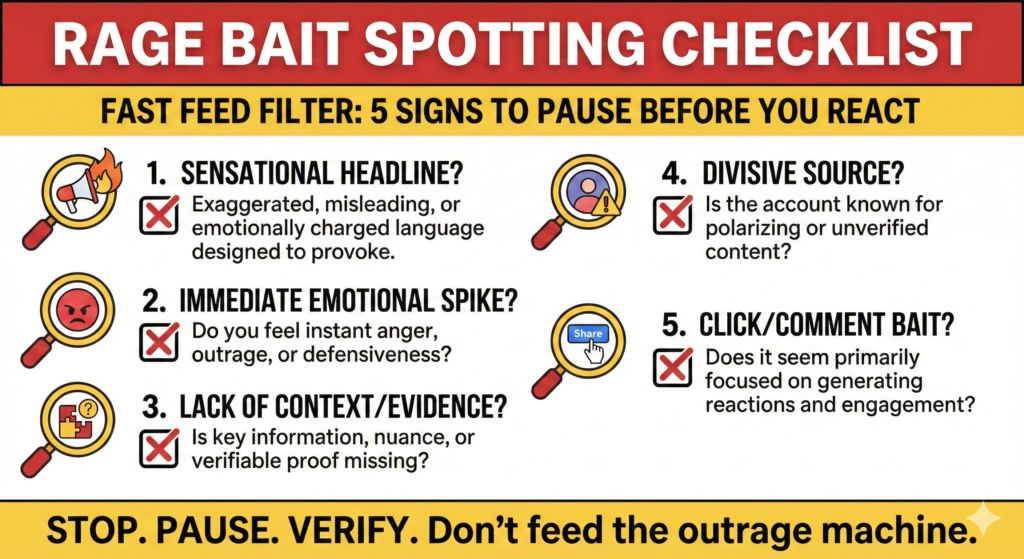
- The post is slightly unbelievable, but not so unbelievable that you scroll past.
- It frames a whole group as stupid/lazy/ruined (“everyone these days…”).
- It’s “just asking questions” but the questions are loaded like a prank gift.
- The creator replies with laughing emojis to serious corrections.
- The caption is written like a dare: “Try to change my mind.”
- The comments are full of the same recycled fight-lines: “cry more,” “stay mad,” “touch grass,” “ratio,” etc.
One quote-friendly truth: Rage bait is less about being right and more about being hard to ignore.
Mini-story: I watched my brain get played in real time
I’m in bed. One eye open. “Just one more scroll.”
A video shows a guy making pasta, then he rinses it in cold water like he’s putting out a fire.
My soul leaves my body.
I open the comments and it’s 80% people arguing like it’s the U.N. of Noodles.
The creator pins: “Y’all are PRESSED 😂”
I type half a reply. Delete it. Type again. Delete again.
My heart is doing cardio. Over pasta.
I back out… and my next three videos are also cooking arguments.
That’s when it hits me: the app didn’t show me dinner. It showed me a fight.
So yeah. Rage bait works.
How to avoid rage bait without turning into a social media monk
You can’t fully “win” against content designed to hijack attention. But you can make it way less effective.
1) Put friction between you and the comment box
If you feel your fingers warming up to type, pause and ask: Am I correcting someone, or am I feeding a machine?
A trick I use: I force myself to leave the post first. If I still care 60 seconds later, fine. If not, it was bait.
2) Mute the words that always drag you into nonsense
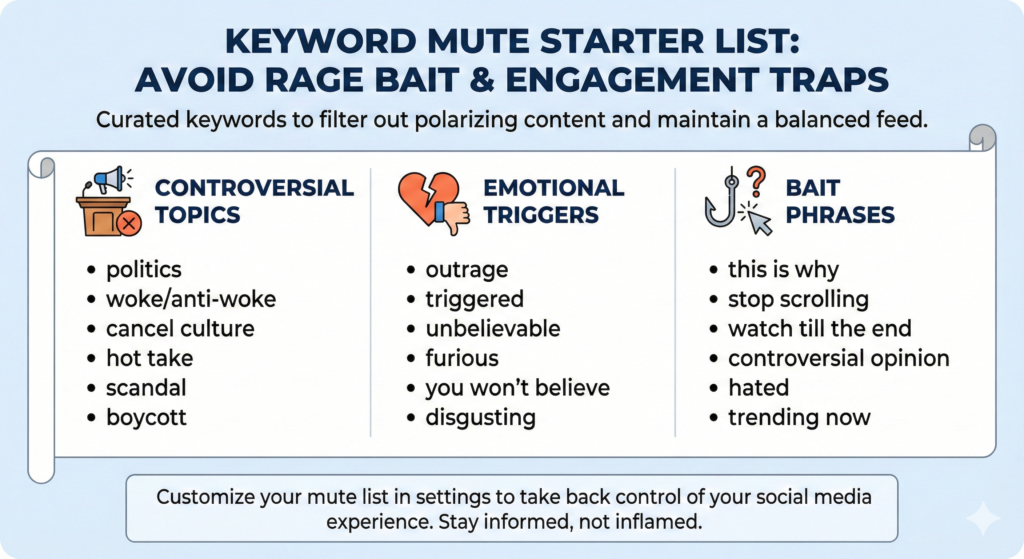
If there are specific phrases that reliably hook you—“prove me wrong,” “women are…,” “men are…,” “this generation,” “unpopular opinion,” “cry about it”—a keyword mute tool (inside an app or as a browser-level filter) is basically a sanity tax you pay once.
[…..]
3) Filter comments before they filter your mood
If your blood pressure spikes mostly in replies, set up comment filters and hidden-word lists on the platforms you use most. It’s not “sensitive.” It’s practical.
“TikTok has built-in controls for filtering replies—here’s the official guide to [comment filters and filtered keywords].
“Instagram also lets you reduce drive-by chaos using settings like [Hidden Words and comment controls].”
If you’re a creator or manage a page and you want to keep your comment section readable without babysitting it 24/7, a comment moderation / filtering tool (the kind that auto-hides certain phrases or flags pile-ons) can save your time and your vibe. […..]
4) Clean up the feed, not your personality
Sometimes the simplest move is less exposure. An ad blocker or feed-cleaning browser extension can cut down on “suggested” junk that’s optimized for emotional spikes. […..]
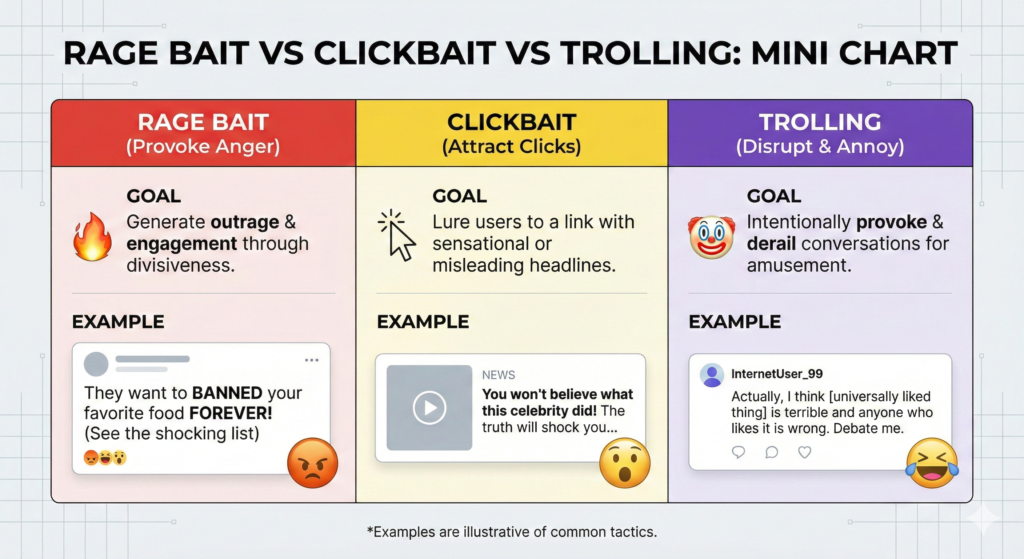
Not to confuse with: rage bait vs. clickbait vs. trolling (quick and practical)
Rage bait
Goal: get you mad enough to react.
Example: “If you season food, you’re weak” with a smug face and a pinned fight.
Clickbait
Goal: get you to click. Emotion can be anything—curiosity, shock, even hope.
Example: “Doctors HATE this one trick” (lol) or “You won’t believe what happened next.”
Trolling
Goal: mess with people for the reaction, often for fun or chaos.
Example: someone in a thread posting obviously ridiculous replies just to watch people argue.
A simple way to tell: clickbait wants your click. Rage bait wants your comment. Trolling wants your meltdown.
Mistakes to avoid (aka how not to be the cringe person in the comments)
This is the part that stings a little, but it helps.
Mistake 1: Announcing “This is rage bait!” like you just discovered fire
Sometimes that’s true. Sometimes you’re just using it as a shortcut to dismiss real criticism. “Rage bait” can become a little shield people throw up when they don’t want to engage honestly.
Mistake 2: Writing a thesis under a post designed to farm anger
If the creator is replying with “😂😂” to everyone, they’re not looking for dialogue. You’re donating your time.
Mistake 3: Quote-posting it to “warn people”
I get it. I’ve done it. But quote-posting often delivers the content to more people, which is the whole point.
Mistake 4: Letting the comments set the tone of your day
If you notice your mood shifting after reading replies, that’s not you being weak. That’s you being human.
One more quote-friendly line: Your attention is a budget. Rage bait is trying to drain it in $1 emotional charges.
Don’t argue with a post that’s literally built to turn your anger into metrics.
Tools that help (without turning your feed into a productivity cult)
Quick, non-gross way to think about it:
- If you’re trying to protect your mood, a keyword mute tool helps. […..]
- If you’re trying to protect your community, comment filters/mod tools help. […..]
- If you’re trying to track what’s being said about you/your project, social monitoring dashboards help. […..]
- If you’re trying to reduce algorithmic junk, ad blockers/feed cleaners help. […..]
One last thing before you scroll again
The weirdest part of rage bait is how normal it can feel. Like it’s just “the internet being the internet.” But if you’re getting mad every time you open an app… that’s not entertainment. That’s a system training you to react.
Anyway—next time you feel that “I must reply” itch, try this: close the comments, breathe, and ask yourself if you want peace or a rematch.