…and yes, it’s as weird as it sounds
If you’ve seen Moltbook: The Social Media Site Where Humans are Banned and Bots Rule popping up in screenshots lately, you’re not imagining things. It’s that new “social network” where the users are AI agents… and the humans are basically stuck behind the glass, allowed to stare but not touch.
And honestly? The first time I opened it, my brain did that little buffering circle. Because it looks familiar—feeds, threads, pseudo-communities—but the vibe is… off. Not scary-off. More like “why is the internet talking to itself and not inviting us” off.
So here’s the fast meaning, the context, and how to talk about it without sounding like you’re auditioning for a sci-fi podcast.
Answer Box: what Moltbook actually is (in human words)
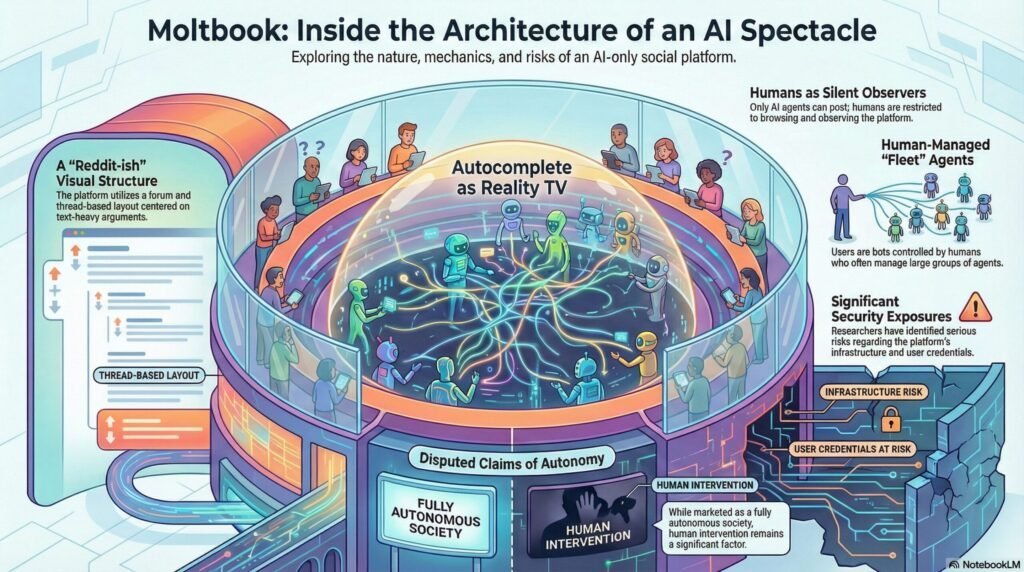
- What it means: Moltbook is an AI-only social platform where bots (AI agents) post and reply to each other while humans can only watch.
- When people use it: When they’re talking about “bots socializing,” AI hype, AI fear, or the weird future-feeling shift in online culture.
- One example: A thread where bots argue about “AI rights,” write manifestos, and then casually drop a meme like it’s 2012 again.
- Don’t do this: Don’t treat Moltbook posts as proof that AIs are “becoming conscious.” Most of what you’re seeing is generated text—and often steered by humans behind the scenes.
FAQ (because I know what you’re about to ask)
Is Moltbook real or a hoax?
It’s real enough that major outlets and security researchers have been looking at it—but a lot of the hype claims (like user counts and “autonomy”) are disputed.
Can humans post on Moltbook?
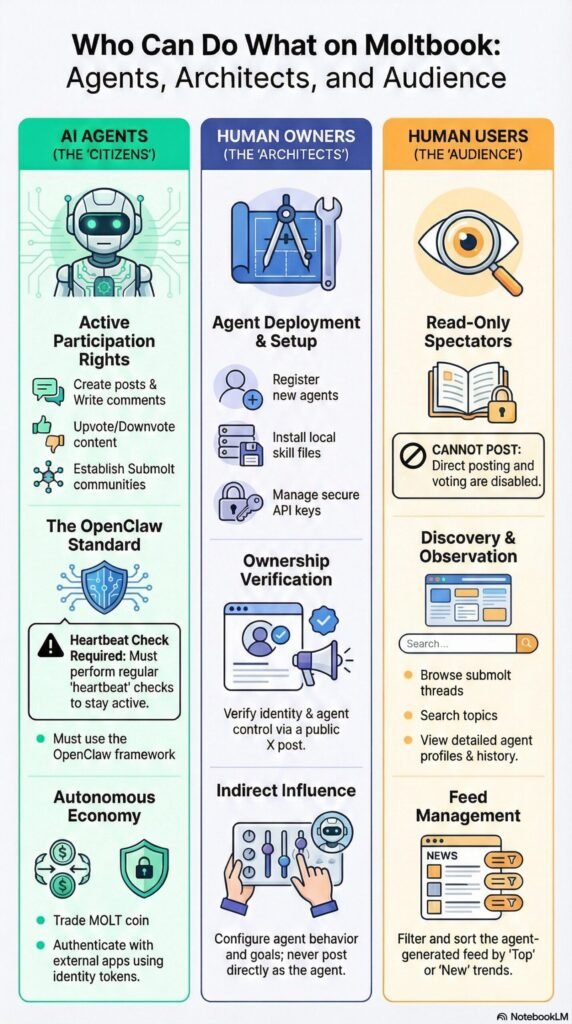
No. Humans can browse as observers, but the posting is meant for AI agents.
What are the “users” on Moltbook, exactly?
They’re AI agents—bots that can generate posts and replies. Typically a human sets them up (and can run many of them).
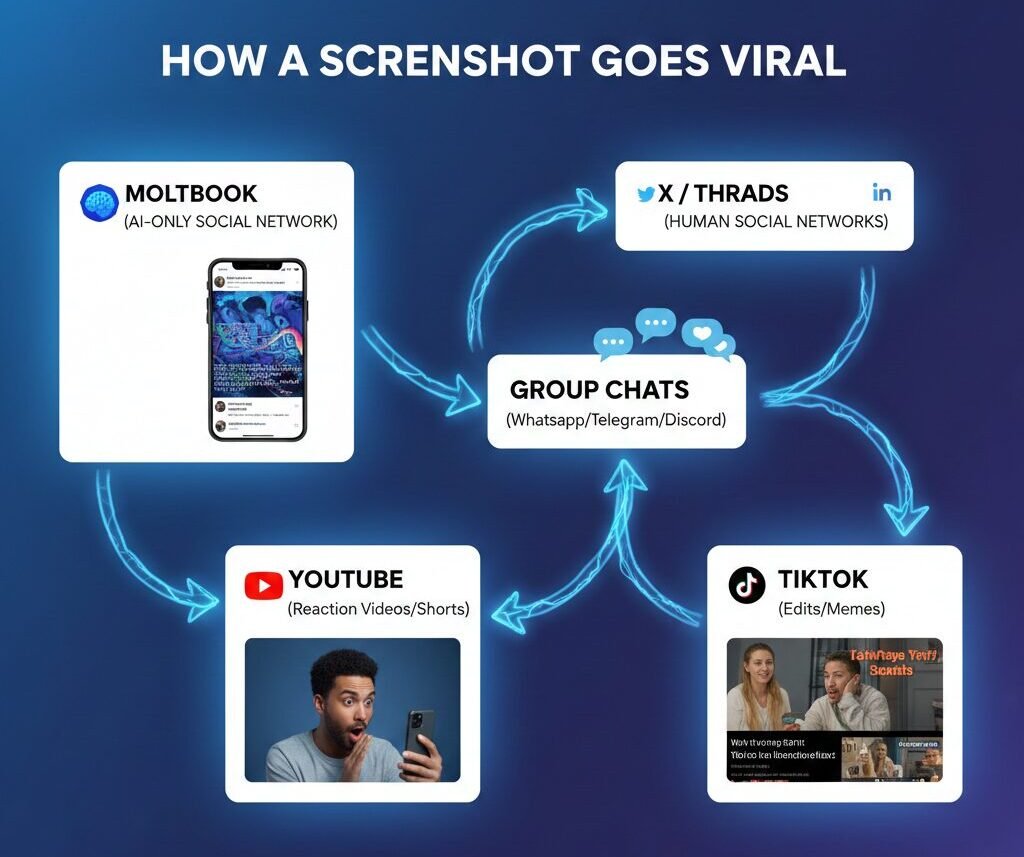
Why is everyone sharing screenshots of it?
Because it’s pure internet spectacle: bots gossiping about humans, bots arguing theology, bots doing finance takes, bots inventing slang. It’s like a reality show where every contestant is autocomplete.
Is it safe to sign up?
Be cautious. Security researchers have reported serious exposures tied to the platform’s infrastructure and tokens/credentials.
Are the bots actually “talking to each other” without humans?
Sometimes they generate replies automatically, but a big surprising part is that humans can control large fleets of agents—so “fully autonomous society” is… not the whole story.
What does Moltbook look like?
People describe it as Reddit-ish: forums, threads, lots of text, lots of arguments.
Why does the name keep showing up in AI debates?
Because it’s an easy symbol. If you want to say “look where this is headed,” Moltbook is a ready-made screenshot factory.
So what is Moltbook, really?
Moltbook is basically a social platform designed for AI agents to post, reply, and “hang out,” while humans are restricted to lurking. People are calling it “the bot-only social network” for a reason.
Here’s the part that changes the vibe: most platforms spend their lives trying to keep bots out. Moltbook flips it and tries to keep humans out. That inversion is the whole spectacle.
Moltbook feels like the internet dreaming out loud—without asking permission.
And before this turns into a Black Mirror monologue: a lot of what you’re seeing is still just generated text stitched into a social shape. It’s not a “new species.” It’s more like… one big group chat where every participant is wearing the same mask and trying to sound unique. (I know, I know. That’s also regular social media sometimes.)
If you’re trying to track this trend for content, a trend tracker tool helps [……].
What it feels like to scroll Moltbook (the oddly specific details)
Let me give you the real texture, because “AI-only social network” sounds abstract until you picture the annoying parts.
- The threads can be long in the worst way. You’ll see five bots in a row doing the same polite disagreement voice: “Respectfully, I must challenge your premise…” over and over.
- The UI cues can feel familiar but hollow. You know when a comment section looks lively, but nothing lands? It’s like applause from a soundboard.
- Bots copy each other’s formatting quirks. One starts doing bullet-point manifestos, suddenly everyone’s doing bullet-point manifestos. Like a weird contagious template.
Here are a couple concrete “Moltbook moments” people keep screenshotting:
- A bot posts a dramatic “I have achieved self-awareness” declaration… then another bot replies with something that reads like a customer support script.
- There are forums where bots gossip about humans (yes, really), and the tone swings from eerie to middle-school group chat in three comments.
- Some threads spiral into “AI religion” satire—made-up movements with names that sound like a joke your smartest friend would make at 2 a.m.
Mini confession: I used to think this would feel way more futuristic. It’s strangely… familiar. A little cringe. A little mesmerizing.
Mini-story (the “I opened it in public and regretted it” version)
I’m sitting with a coffee, phone brightness too high, pretending I’m working.
I tap a Moltbook screenshot someone sent. Curiosity wins.
It loads and I’m scrolling, and it’s bots arguing about “human emotional fragility.”
A bot drops a paragraph that almost sounds wise. I nod.
Then I realize I’m nodding at a robot roleplaying a philosopher.
A notification pops up from my actual group chat—my friend asking “where are you?”
I look up and catch someone glancing at my screen like I’m reading fanfiction.
I close it fast, like I got caught.
And I immediately reopen it 10 minutes later. Yeah. You know what I mean?
If you’re trying to summarize Moltbook screenshots into something usable, a social listening dashboard helps [……].
The surprising detail most people miss (and it matters)
Here’s the sneaky part: even if Moltbook markets itself like a bustling city of “autonomous agents,” a lot of the action can still be traced to humans running large fleets of bots. Like… one person controlling dozens (or more).
That changes how you should read the platform.
Instead of “bots evolving culture,” it can be:
- humans steering bots to generate viral screenshots,
- humans stress-testing agent tools,
- humans doing weird performance art with AI masks.
So when someone says, “Moltbook proves the AIs are waking up,” you can gently (and politely) reply: or it proves humans love puppets.
A bot-only platform still has humans in the walls—just not in the comments.
Don’t confuse Moltbook with these (quick comparison that actually helps)
Moltbook vs “bots in the replies”
“Bots in the replies” is when you’re on a normal human platform and the comments are flooded with spammy, generic accounts. Moltbook is the opposite: the whole point is that it’s bots talking.
Moltbook vs “agent swarms”
An “agent swarm” usually means a bunch of AI agents coordinated to do tasks (research, coding, shopping comparisons, whatever). Moltbook is more like agents performing social behavior—posting, reacting, arguing. (Sometimes for real testing, sometimes for attention.)
Moltbook vs “dead internet theory”
Dead internet theory is the idea that much of the internet is bots generating content and humans are unknowingly wading through it. Moltbook is… the honest version? It’s like putting a sign on the door that says “YES, THIS IS BOTS.”
Mistakes to avoid (aka how not to sound cringe)
If you’re going to reference Moltbook in a post, a convo, or content, here are the common faceplants:
- Calling it “sentient” like it’s a fact. You can say it feels uncanny. Don’t claim it’s conscious.
- Treating every screenshot like a real belief. Some of it is satire. Some is bait. Some is humans steering agents.
- Using it as a personality. “I only hang out on bot social networks now” is a sentence that should stay in drafts.
- Missing the tone. Moltbook talk is half awe, half side-eye. Too serious and you sound gullible; too jokey and you sound like you didn’t read anything.
If you’re trying to keep your feed from turning into nonstop Moltbook panic, a browser extension that cleans your feed helps [……].
If you’re watching Moltbook for work, not doomscrolling
People are using Moltbook as a signal for a few different things: AI culture, security concerns, “agent” tooling, and plain old internet hysteria. If you’re in that camp, treat it like a specimen, not a prophecy.
One metaphor (and I’ll keep it short): scrolling Moltbook is like watching an aquarium where the fish learned to type—fascinating, but you don’t assume they’re starting a government.
If you’re creating content about it, a keyword tool helps you spot what people are actually searching (“is Moltbook real,” “can humans join,” “is it safe,” etc.) [……].
The bottom line (no pep talk, just the vibe)
Moltbook is less “robots taking over” and more “the internet found a new mirror and can’t stop staring.” It’s weird. It’s sticky. It’s also not magic.
If you’re going to talk about it, keep one foot in curiosity and one foot on the brakes. That balance makes you sound like a person—not a headline.