
When Parasocial pops up in your feed, it’s usually because someone’s saying, “Hey… this is starting to feel a little too personal for a one-way internet thing.”
Like: you’ve never met this creator, but your brain is acting like you have. Not in a “you’re weird” way—more in a “your brain is doing what brains do” way. (Annoying, but true.)
Answer Box: Parasocial, in plain English
- What it means: A one-sided bond where you feel close to someone online who doesn’t actually know you.
- When people use it: When fandom starts looking like friendship (or breakup).
- One example: You watch every livestream, feel “seen,” and get genuinely hurt when they don’t respond.
- Don’t do this: Don’t treat access (DMs, replies, lives) like you’re owed a relationship.
Parasocial: quick FAQs people actually search
Is a parasocial relationship always bad?
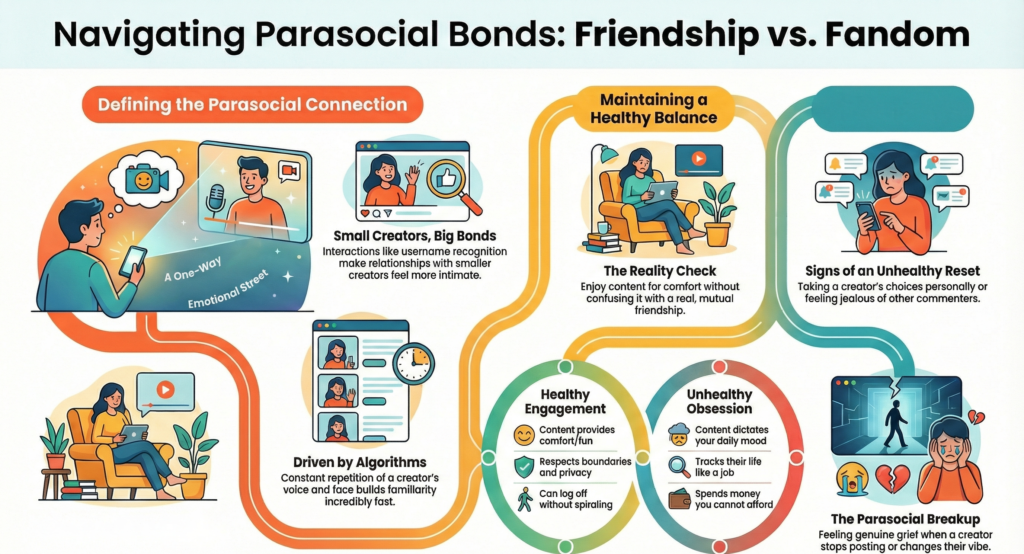
No. A lot of parasocial stuff is basically “I like this person’s content and it comforts me.” That can be totally fine—until it starts messing with your mood, money, time, or real relationships.
What’s a parasocial relationship, exactly?
It’s when the emotional connection feels real on your side, but the other person doesn’t actually know you. Even if they’re “nice” or interactive, it’s still not mutual in the normal friendship sense.
Can it happen with small creators, not just celebrities?
Yep. Honestly, it can be stronger with smaller creators because they reply more, remember usernames, and the vibe feels more intimate.
Is it parasocial if I just admire someone?
Admiration alone isn’t it. Parasocial is more like: “This person is part of my life, and they should act like it.”
Why does it feel so intense?
Because it’s designed to. Algorithms push the same face, voice, and inside jokes at you every day. That repetition builds familiarity fast.
What’s a “parasocial breakup”?
When a creator stops posting, changes their vibe, gets cancelled, or blocks you—and you feel real grief. It can feel silly and still hit hard.
Can parasocial relationships be healthy?
Yes—if you keep boundaries: you enjoy the content, don’t confuse it with friendship, and you can log off without spiraling.
How do I know if it’s getting unhealthy?
If you’re tracking their life like it’s your job, spending money you can’t afford, feeling jealous of people in their comments, or taking their choices personally—yeah, it’s time to reset.
So… what does Parasocial really mean?
Parasocial is that weird in-between space where someone online starts to feel like your person—your comfort streamer, your “big sister” creator, your podcast host who “gets you,” your favorite musician who “saved your life.”
Here’s the part people miss: Parasocial isn’t only about obsession. It’s also about familiarity masquerading as closeness. You see someone’s face every day. You know their dog’s name. You know their “I’m about to rant” voice. You know what they order at Starbucks because they filmed it 400 times.
Your brain goes: We know them.
But knowing about someone isn’t the same as being known.
It’s like your brain hitting “autofill” on a relationship form. Same inputs every day → your brain fills in “closeness” without asking permission.
“If you want a clean, non-drama definition, [parasocial interaction] is explained in a straightforward way.”
It’s a useful read if you want the “what is this” part without a 40-tweet thread.
What Parasocial looks like in real life (not just “fans are weird”)
Let’s do actual examples, because “online relationship” is too vague to be helpful.
Example 1: The livestream micro-hit
You’re watching TikTok Live. The creator says, “Oh hey, your username is here!”
Your stomach does that little flip.
They read your comment out loud.
You screenshot it.
Later, you find yourself thinking, I should show up early next time so they notice me again.
That’s parasocial fuel: tiny moments of recognition that feel like intimacy.
Example 2: The comment section spiral
On Instagram, they post a Story about “fake friends” and suddenly you’re doing detective work like you’re in a crime drama.
Was that about their partner? About their best friend? About us?
You reply with a long message trying to “support them,” then stare at “Seen” like it’s a heartbeat monitor.
Example 3: The YouTube “I know you” energy
On YouTube, you’ve watched every video for two years. You can predict their jokes. You know the intro music.
Then they post: “Taking a break. Please respect my privacy.”
And your first reaction is… offended. Like they personally rejected you.
That’s the key signal: when you start taking their boundaries personally.
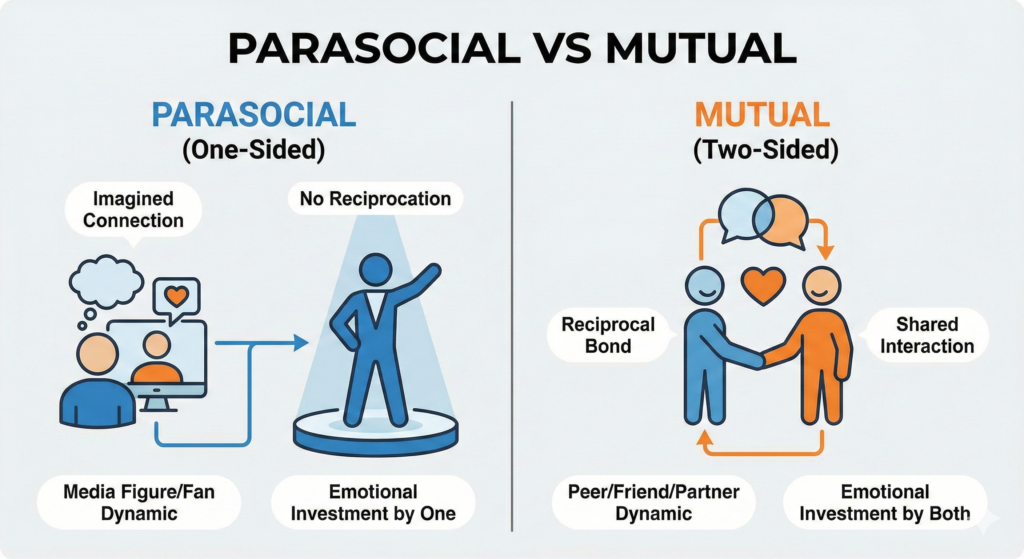
Familiar doesn’t automatically mean close.
Mini-story time (because this is where it gets painfully relatable)
I ignored this for way too long, but here’s a situation I’ve seen a lot:
You’re having a rough week.
You open your phone and go straight to the creator who always makes you feel better.
They’re not posting.
So you refresh. Again. And again.
Then you see they posted… but only to their “close friends” or subscribers.
Your brain goes: Oh. So I’m not in the circle.
You feel embarrassed for caring.
Then you feel mad at them for “making you feel that way.”
Then you feel worse, because—come on—this is a stranger.
That’s the parasocial loop: comfort → access → emotional stakes → spiral.
Have you ever caught yourself doing the refresh thing? Be honest.
Why it happens (and why it’s not a personal failure)
A lot of people use “parasocial” like it’s a moral verdict. Like: Cringe. Get a life.
But parasocial bonds happen because the internet mixes together things that used to be separate:
- Entertainment
- Community
- Confession
- Direct interaction
- Algorithms that push the same person into your face daily
Creators also talk to you, not just at you. Camera eye contact, “besties,” “I love you guys,” Q&As, daily vlogs, “I’m telling you this because you’re the only ones I trust”… you know what I mean?
And there’s a surprising vibe thing here: “Parasocial” gets used as a shutdown word.
Sometimes people throw it at anyone who’s emotionally invested—like caring automatically equals unhealthy. It doesn’t. Humans care. That’s normal.
The real question is: Is your caring costing you something?
Parasocial relationships: healthy vs “uh oh”
Here’s a simple way to tell the difference.
Healthy-ish parasocial (usually fine)
You enjoy the content.
You can miss a post and not feel anxious.
You don’t expect replies.
You don’t feel entitled to their time, body, politics, or personal life.
You could stop watching and be… okay.
“Uh oh” parasocial (time to set boundaries)
You feel jealous of other fans.
You spend money to “prove” loyalty.
You DM them like you’re in a real friendship conflict.
Their mood becomes your mood.
You feel rejected when they don’t engage.
You defend them like they’re family—even when they’re clearly wrong.
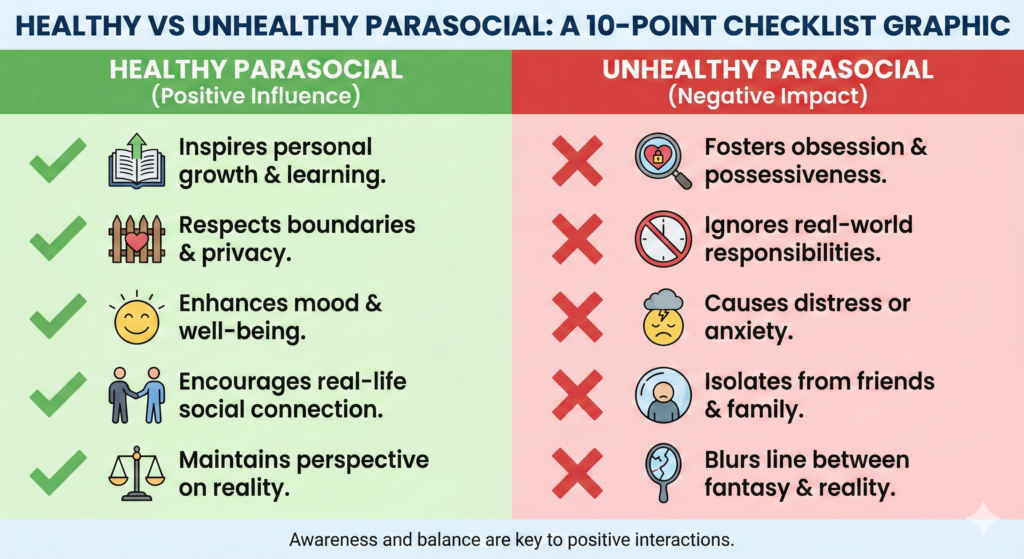
Enjoying someone’s content is normal. Feeling entitled to them isn’t.
Don’t confuse Parasocial with these (quick comparisons)
People mix these up constantly, and that’s where the cringe misunderstandings happen.
Parasocial vs “I’m a fan”
Being a fan is: “I like their stuff.”
Parasocial is: “I feel like we have a bond.”
Parasocial vs “stan”
“Stan” is more about intense fandom behavior and identity (“I ride for them”).
Parasocial is about perceived closeness (“they’re basically in my life”).
Parasocial vs “simp”
“Simp” (usually used rudely) is about over-the-top praise or chasing someone’s approval.
Parasocial can include that… but it’s wider. You can be parasocial without being flirty at all.
Parasocial vs actual community
A community is mutual. People know each other, talk back and forth, have shared norms.
Parasocial is centered on one person you don’t actually know, even if you’re surrounded by other fans.
Mistakes to avoid (the “don’t be that person” section)
This is where most people get called parasocial, honestly.
- Using therapy language at a creator.
“You’re triggered,” “you’re gaslighting,” “this is narcissistic behavior.”
Like… maybe don’t diagnose strangers from a thumbnail. - Acting like access is a contract.
If they replied once, it doesn’t mean they owe you forever. - Oversharing in their comments like it’s your diary.
A quick “this helped me” is sweet. A 17-paragraph trauma dump can put everyone in a weird spot. - Treating their partner/friends as villains.
The “they changed” storyline is often just… a person growing up. - Being a mod in your imagination.
Reporting other fans, policing jokes, fighting “on their behalf” when they didn’t ask.
If you’ve ever typed a comment, deleted it, retyped it, and thought “is this too much?”—that’s your cue. That’s a good cue.
Boundaries that don’t kill the fun
Parasocial boundaries don’t have to be dramatic. It’s not “delete everything and move to a cabin.” (Although honestly, tempting.)
Try these:
- Switch from “always” to “sometimes.” Don’t watch every upload. Miss one on purpose.
- Turn off push notifications for the one person you binge. The “they posted!” ping is basically a leash.
- Keep your support proportional. If you can afford to pay for content, cool. If you’re skipping essentials to “show love,” stop.
- Don’t DM when you’re dysregulated. If you’re angry/sad/in your feelings, draft it in Notes and wait a day.
- Get one offline anchor. A hobby, a friend, a routine—anything that isn’t tied to their posting schedule.
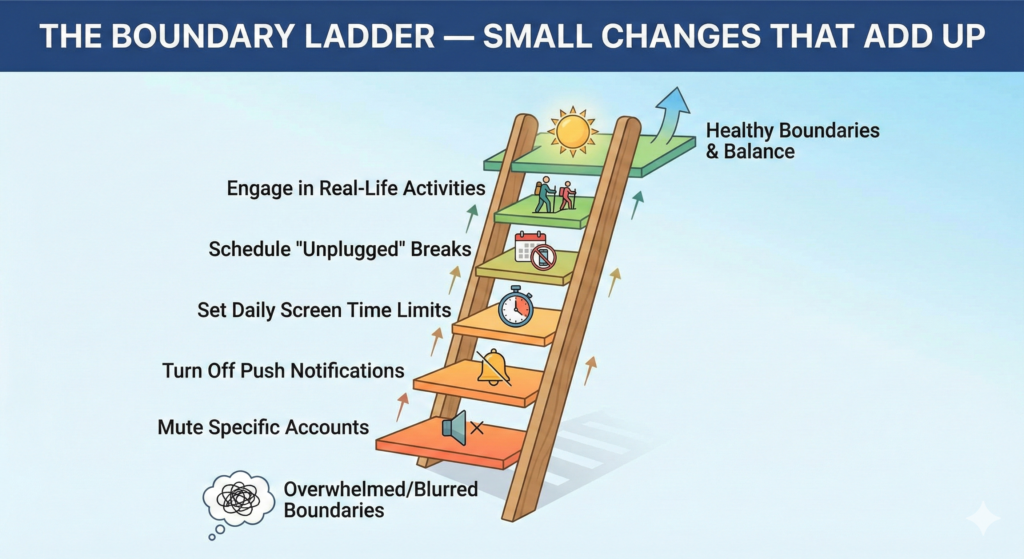
Tools that help (without turning your life into a self-improvement project)
No “top apps” here. Just tool types that match the problem.
If your goal is “Stop spiraling and checking their page 30 times”, a digital wellbeing timer / schedule tool helps because it forces a pause before the reflex kicks in.
[…..]
If you want to use built-in phone limits, [Screen Time App Limits] walks through setting app limits and downtime.
Even if you’re not on iPhone, the idea is the same: make the default harder to overdo.
If your goal is “I love the community, but the comments wreck my mood”, look for a feed-cleanup tool: keyword filters, muted words, comment hiding, “not interested” helpers, that kind of thing.
[…..]
“If you’re a creator and need a simple way to stop one person from derailing your comments, [Hide user from channel] is the official option.”
It’s one of those features you don’t think about until you really, really need it.
If your goal is “I run a community and parasocial drama keeps exploding in the server”, a community moderation tool helps: keyword filters, slowmode, rule prompts, auto-flagging, that kind of boring-but-saving stuff.
[…..]
“For Discord servers, [AutoMod FAQ] explains keyword filters and rule-based moderation tools.”
Worth skimming so you don’t have to invent moderation from scratch at 2 a.m.
And if your goal is “I still want updates, just not the emotional rollercoaster”, try a newsletter-style recap tool (daily/weekly digests, inbox sorting, “only show me highlights”) so you’re not living inside the algorithm’s mood swings.
[…..]
Quick, casual note: some links on this site may be affiliate links. If you buy through them, it helps keep the lights on (thank you), but it doesn’t change what I write.
Parasocial isn’t a crime. It’s just a signal. If your “favorite creator comfort” starts feeling like “my day depends on this,” that’s your moment to step back—before the internet starts steering your feelings like a shopping cart with one busted wheel.