
You’ve probably seen Quiet Quitting in a comment thread where someone posts a screenshot of their boss texting “quick call?” at 9:47 p.m. Or in a TikTok where the vibe is basically: I’m done being the office hero for free.
And then the internet does what it does—half the replies go “YES, protect your peace,” and the other half go “So you’re lazy?” (Which… no.)
Quiet Quitting isn’t a secret plan to do nothing. It’s more like flipping the “always-on employee” setting to off. You know what I mean?
I used to think the phrase was dramatic. Like… can we not call it “quitting” if you’re still employed? But I ignored this for way too long, because the term actually points at something real people are tired of.
Answer Box: Quiet Quitting, in human language
- What it means: Doing your job… and not the extra unpaid stuff that quietly became “expected.”
- When people use it: When they’re burned out, underpaid, or tired of being rewarded with more work.
- One real example: You stop replying to messages after work hours, decline “optional” meetings that aren’t actually optional, and stick to your role.
- Don’t do this: Don’t ghost your team or sabotage deadlines and call it “boundaries.” That’s not the same thing.
Quiet quitting isn’t ‘doing nothing.’ It’s doing the job you were hired to do—no more, no less.
FAQ people actually ask about Quiet Quitting
Is Quiet Quitting the same as being lazy?
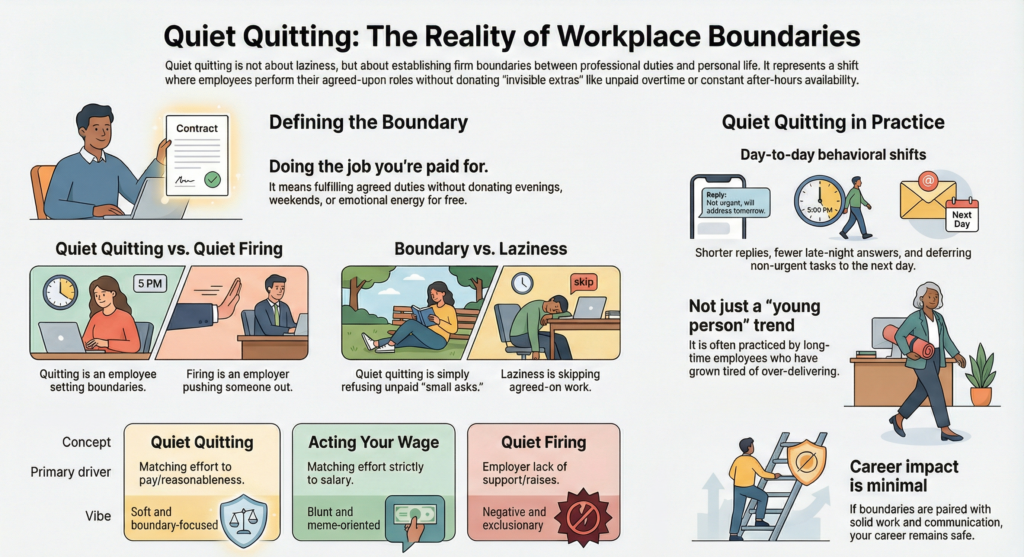
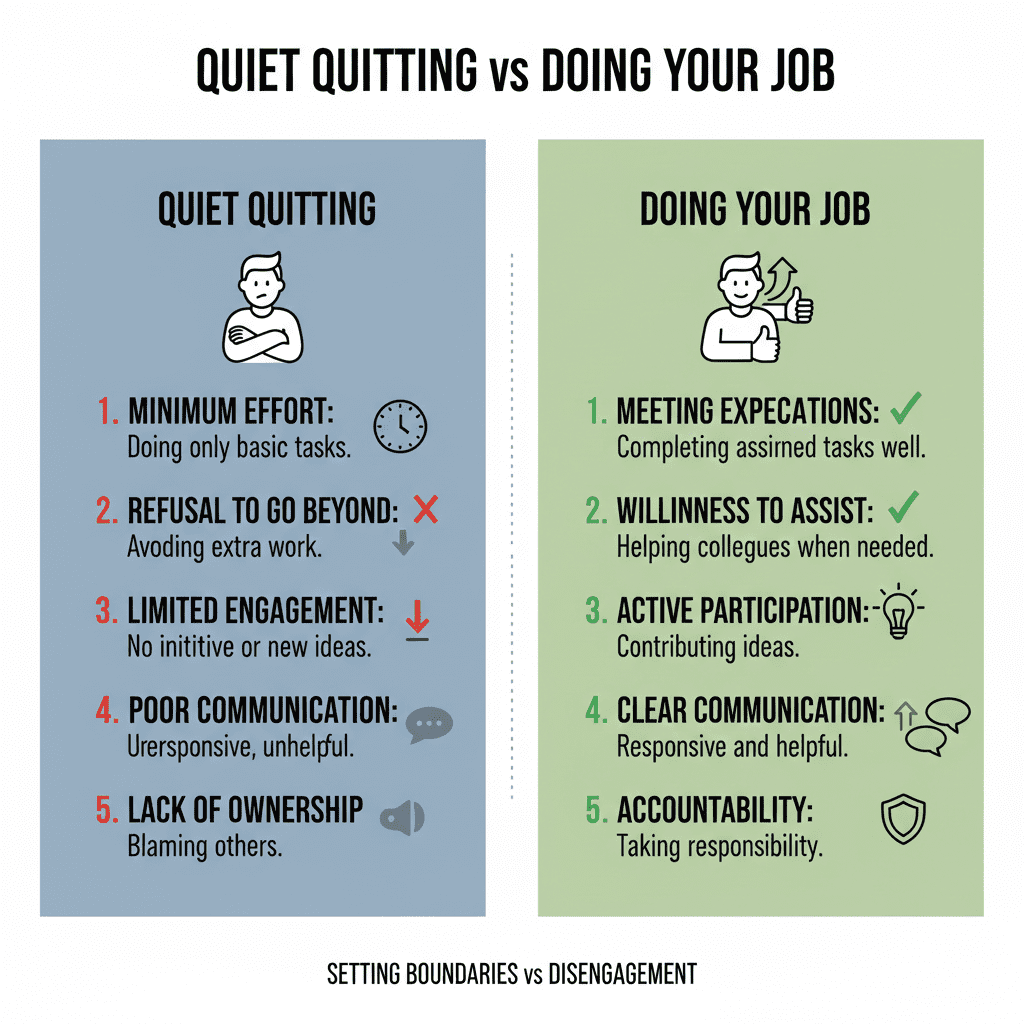
No. Lazy is skipping work you agreed to do. Quiet quitting is doing the work you agreed to do… and not donating your evenings, weekends, and emotional energy for free.
Does Quiet Quitting mean you hate your job?
Not always. Sometimes it means you like your job but hate the job plus the invisible extras (the constant pinging, the “can you just…,” the unpaid overtime that magically became normal).
Is Quiet Quitting basically “acting your wage”?
They’re close cousins. “Acting your wage” is more blunt and meme-y. Quiet quitting is the softer, work-world way of saying “I’m matching effort to what I’m paid and what’s reasonable.”
Why did Quiet Quitting blow up so fast?
My opinion: because a ton of people realized they were doing two jobs—one on paper, and one in all the “small asks” that never end.
Can Quiet Quitting hurt your career?
It can if it turns into poor communication or missed deadlines. If it’s healthy boundaries plus solid work, you’re usually fine. (And if you’re not “fine,” that tells you something too.)
Is Quiet Quitting only a young person thing?
Surprising detail: not really. The loudest discourse is online (so it looks young), but the people quietly doing it are often longtime employees who used to over-deliver and finally got tired of it.
What does Quiet Quitting look like day-to-day?
Usually boring stuff: shorter replies, fewer late-night answers, fewer “sure, I’ll take that on,” and more “I can do that tomorrow.”
Is it the same as “quiet firing”?
Nope. Quiet quitting is an employee setting boundaries. Quiet firing is an employer slowly pushing someone out (less support, fewer opportunities, vague feedback, no raises). Different energy entirely.
So… what is Quiet Quitting, actually?
Quiet Quitting means you’re still working—you’re just not going above and beyond in ways that aren’t recognized, paid, or sustainable.
The myth-bust part: it’s not a plot to do the bare minimum forever. It’s usually a reset after a stretch of doing too much.
Here’s the easiest way to think about it (one metaphor, promise): Quiet Quitting is like turning on “Do Not Disturb” on your phone. You’re not throwing the phone away. You’re just done answering every ping like it’s a fire alarm.
And the term has a vibe that people miss: it’s often less “I don’t care” and more “I cared too much for too long and it cost me.”
Why Quiet Quitting spread (and why it hit a nerve)
A lot of people first saw “quiet quitting” everywhere around 2022 (that’s when it exploded in feeds, at least from what I saw). But the behavior is older than the phrase.
What changed is the pile-up:
- Work apps made “after hours” fuzzy. One message turns into a thread. One thread turns into “just five minutes.” Five minutes turns into… you’re still on your laptop at 10:30.
- “Urgent” got overused. When everything is urgent, nothing is. And people stop donating urgency like it’s a personality trait.
- Good workers got “rewarded” with more work. Not a raise. Not a promotion. Just… more work.
Concrete example #1: the “quick call?” trap
You’re done for the day. You’re literally brushing your teeth. Your phone lights up: “Quick call?” with that little typing bubble that makes your stomach drop. You join. It’s 38 minutes. Nobody says thanks. Tomorrow there’s a follow-up. That’s the moment a lot of people decide, quietly, I’m not doing this anymore.
What Quiet Quitting looks like on a random Tuesday
Let me give you a mini-story. Because this is where the term stops being internet-y and starts being… Tuesday.
You’re at your desk. It’s 4:58.
Your calendar is blocked from 5:00–6:00 for “gym / family / life / please don’t.”
A teammate pings: “Hey! Can you review this doc tonight? Super quick.”
You open it. It’s 47 comments, 19 of them tagged at you.
Your boss sends a thumbs-up emoji in a group chat (which somehow feels like an assignment).
You type: “I can review first thing tomorrow morning and get notes back by 10.”
You hit send.
Your heart does that little panic hop like you just committed a crime.
Nothing explodes. The world keeps spinning.
That’s quiet quitting energy.
Concrete example #2: the meeting diet
Someone who’s quiet quitting starts declining meetings that could’ve been an email… and they do it politely. They’ll ask for an agenda. They’ll say, “Can you drop the decision needed here?” They stop attending “syncs” where no syncing happens—just people narrating their inbox.
Concrete example #3: the “extra role” refusal
The social committee. The onboarding buddy duty. The unofficial therapist friend at work. The person who always fixes the slide deck because “you’re so good at it.” Quiet quitting is often just stepping out of those extra roles.
If your ‘going above and beyond’ has become the baseline, you’re allowed to reset the baseline.
Healthy boundaries tips (without turning into the office villain)
Quiet quitting goes wrong when it turns into silence, resentment, and disappearing. Quiet quitting goes right when it turns into clarity.
A few boundaries that actually work in real life:
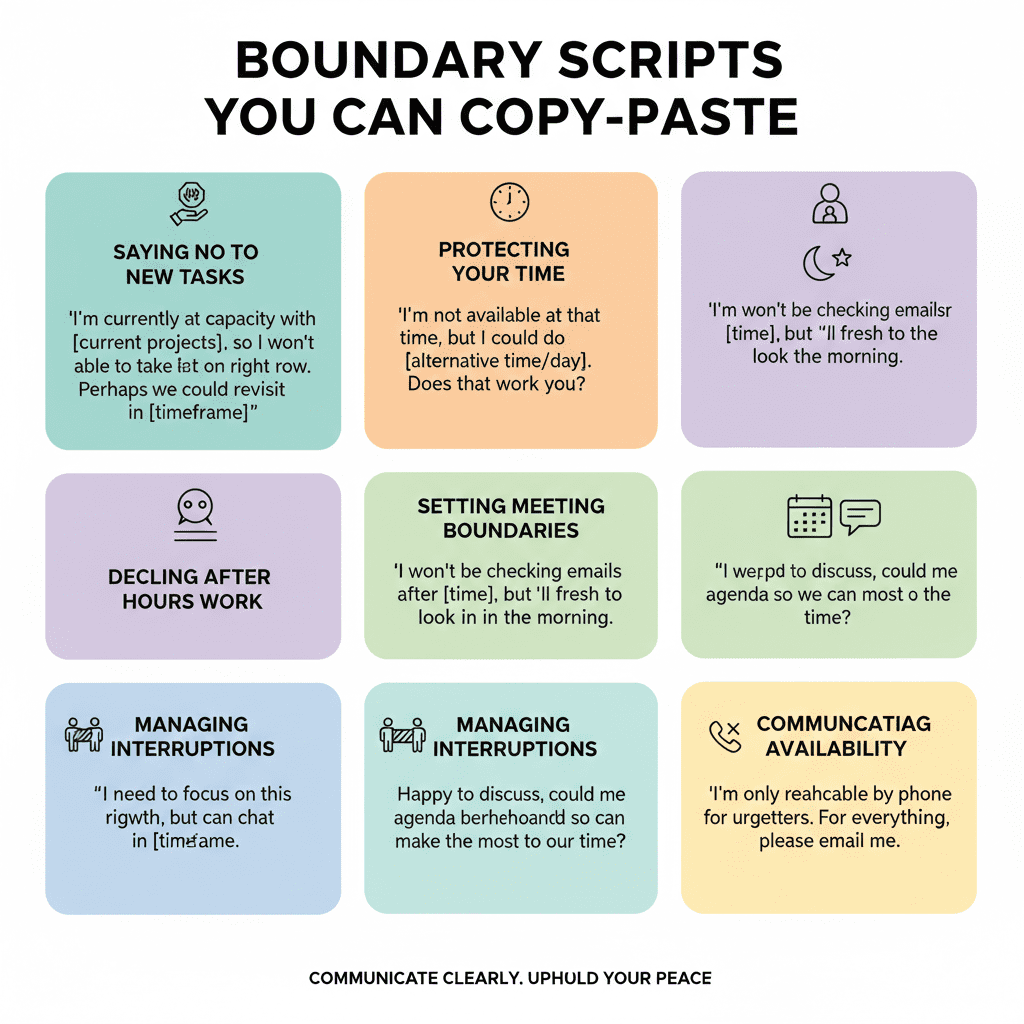
- Name your default response time. “I’ll respond tomorrow morning.” “I’m offline after 6.” Simple. Predictable. Not rude.
- Trade, don’t vanish. Instead of “no,” try: “I can do X by Thursday, or Y by Wednesday. Which matters more?”
- Stop treating every message like a siren. Not every ping is a priority. It just feels like one.
- Document the invisible work. If you’re always the one smoothing things over, training new people, fixing messy handoffs—write it down. Not to be petty. To be accurate.
And yes, there’s a social side to this. If you quietly quit in a way that makes your coworkers pick up the slack without warning, they’ll hate it. Fair. Quiet quitting should be boundary-setting, not surprise-dumping.
If you’re trying to keep your boundaries without spending all day managing chaos, a few types of tools can help (without being cringe about it):
- If you keep getting dragged into “quick tasks,” a time-tracking tool can make your workload visible. [……]
- If your day gets eaten by meetings, a calendar + scheduling tool that enforces focus blocks can protect your deep work time. [……]
Don’t confuse Quiet Quitting with these (and avoid the cringe)
Quick comparison: Quiet Quitting vs. nearby internet cousins
- Quiet Quitting: You do your job. You stop doing the unpaid extras.
Example: “I’ll handle my tasks, but I’m not staying late for last-minute requests every week.” - Quiet Firing: Your company slowly squeezes you out.
Example: your projects get reassigned, feedback gets vague, you’re left out of key meetings. - Burnout: You’re depleted—mentally, physically, emotionally.
Example: you can’t focus, you dread opening your laptop, you’re exhausted even after rest. - Rage applying: You’re mad and applying everywhere.
Example: you have a bad meeting and immediately fire off five applications during lunch.
Quiet quitting is a boundary move. Burnout is a warning light. Quiet firing is a management problem. Rage applying is… honestly, a mood.
Mistakes to avoid (so you don’t accidentally become the problem)
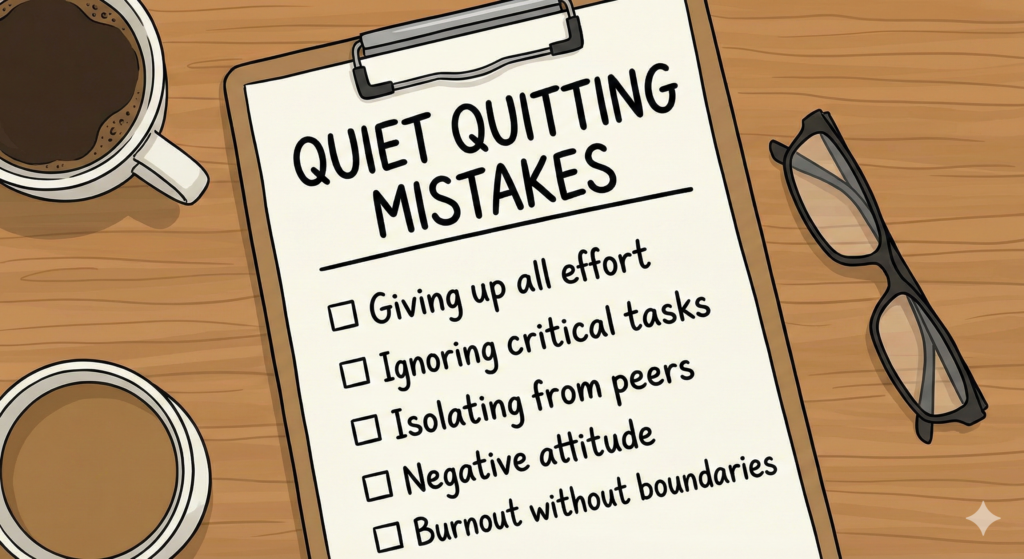
Here’s where people get it wrong:
- Calling it Quiet Quitting while doing sloppy work. That’s not boundaries. That’s… bad performance.
- Ghosting messages with no expectations set. If you’re changing your availability, say so.
- Being passive-aggressive instead of direct. The “seen” and no reply thing? It makes enemies fast.
- Dumping tasks sideways. If you’re stepping back from extras, be transparent so teammates aren’t blindsided.
Tools that make the “reset” easier (without turning into a productivity robot)
This is where the internet sometimes gets annoying, because people act like you need a 19-step system and a sunrise routine. You don’t.
But if you’re trying to hold boundaries in a messy work environment, certain types of tools genuinely help:
- If you’re constantly context-switching, a task manager that shows what’s actually on your plate can prevent “just one more thing” from multiplying. […..]
- If you want to build better work habits (without motivational yelling), a planner system or habit tracker helps you keep commitments realistic. […..]
- If you’re trying to level up skills so you can change roles (or negotiate), a course platform can be a low-drama way to do that after hours—on your terms. […..]
The [APA overview of workplace stress] is a helpful starting point.
One last thing: Quiet quitting isn’t a personality. It’s usually a phase. A correction. A “hey, this isn’t working” moment. If you’ve been giving 120% and getting 0% back, it makes sense that your brain goes, “Cool. New plan.”
And if your workplace can’t handle you doing a normal amount of work in normal hours… that’s not a you problem. That’s a look around problem.