

You’ve probably seen “UGC creator” pop up in weird places lately: a brand’s “work with us” form, a TikTok comment section full of “need UGC creators ASAP,” or that one friend who suddenly has a ring light in their bedroom. And it’s confusing because it sounds like “influencer”… but it’s not.
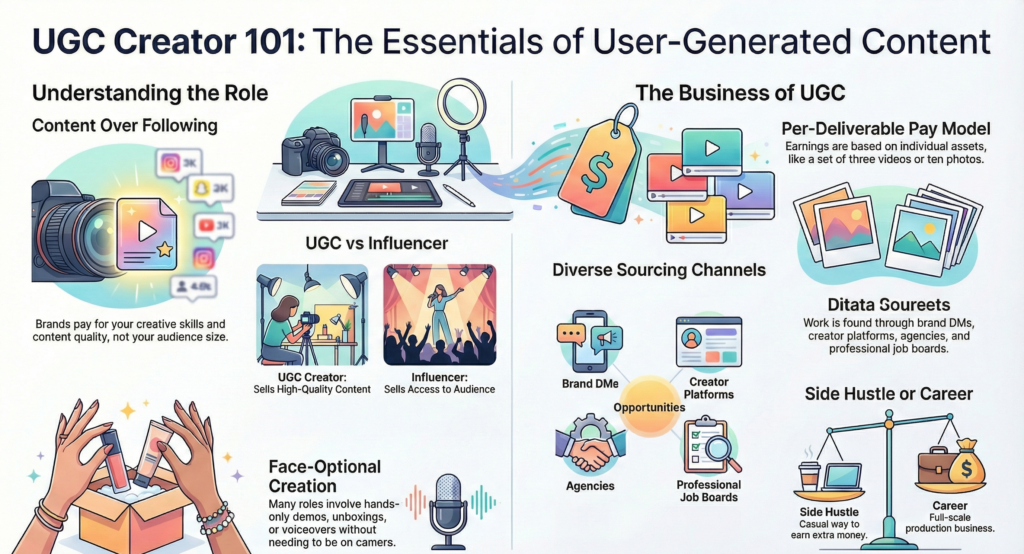
A UGC creator is basically someone brands pay to make content that looks like it came from a real person (because it did). Not a celebrity. Not a glossy commercial. More like “someone talking to camera in their kitchen” energy… you know what I mean?
Here’s the part people miss: a lot of UGC never gets posted on the creator’s own page. The brand uses it on their account, or as an ad, or on a product page. Your follower count can be tiny and you can still get hired.
I used to think UGC creator was just a rebrand for influencer. I ignored the difference for way too long.
Answer Box: UGC creator (fast)
- What it means: A UGC creator makes “user-style” videos/photos for a brand to use in ads, socials, or product pages.
- When people use the term: When talking about paid brand content that looks organic (especially short video).
- Example: “I’ll film 3 vertical videos showing how I use this product, and you can run them as ads.”
- Don’t do this: Don’t pitch UGC like it’s influencer work (“I’ll post to my followers”) unless they asked for posting.
A UGC creator sells content, not clout.
FAQ: the stuff people actually ask
Do you need a big following to be a UGC creator?
Nope. Not usually. Most UGC deals are about your content skills (clear video, decent audio, natural delivery), not your audience size. If a brand wants reach, they’ll ask for influencer posts specifically.
What does UGC stand for?
UGC = user-generated content. In this context, it means content that feels like it came from a regular user, even when it’s paid and planned.
How do UGC creators get paid?
Usually per deliverable (like “3 videos + 10 photos”), sometimes with add-ons for faster turnaround or extra versions. Exact numbers vary wildly depending on the brand, the usage rights, and how experienced you are.
Is UGC creator the same thing as “content creator”?
Not automatically. “Content creator” is a huge umbrella. A UGC creator is a creator who makes brand-ready content that a company can repurpose.
Where do UGC creators find work?
Brand DMs, creator platforms, job boards, agencies, and “apply to collaborate” pages on brand sites. Also… pure chaos. Sometimes it’s literally a brand commenting “email us” under your video.
Do UGC creators have to show their face?
No. A lot of UGC is hands-only: unboxings, product demos, voiceover, screen recordings, “pack an order with me,” that kind of thing. Face-on-camera helps for certain styles, but it’s not a requirement.
Can a UGC creator also be an influencer?
Yes. Some people do both. The difference is what’s being bought: your content (UGC) vs your audience (influencer).
Is UGC creator a real job or just a side hustle trend?
It can be either. Some people do it casually for extra money. Some build a full pipeline and treat it like a production business. Same label, different intensity.
How UGC creator work actually goes (a mini story)
Picture this:
You’re in sweatpants. Hair is doing whatever it wants today.
A brand emails: “Can you film 2 unboxing clips + 1 ‘why I switched’ video?”
They attach a brief that’s 9 bullet points long and somehow still unclear.
They want it “authentic” but also want you to say the slogan word-for-word.
You film in front of a window because your room light makes you look gray.
You redo the first line seven times because you keep saying “um” like a foghorn.
You export the video… and the captions land in the middle of your face.
You fix it, upload to a folder, and name the file “FINAL_final2_reallyfinal.mp4” like a normal person.
That’s UGC. It’s not glamorous. It’s weirdly satisfying.
What brands really want from a UGC creator
Brands say they want “authentic.” What they usually mean is:
They want content that doesn’t trigger the “this is an ad, skip” reflex in the first second.
Here are the quiet preferences that show up in briefs (even if they don’t say it out loud):
- A strong opening line. Not “Hi guys!” More like: “I didn’t expect this to work, but…”
- Bright-ish lighting. Doesn’t have to be studio. Just not dungeon vibes.
- Clean audio. People will forgive shaky video. They won’t forgive bathroom-echo sound.
- Simple visuals. One product, one problem, one payoff. No ten-step montage unless requested.
- Options. Brands love variations: two hooks, two endings, one extra “silent B-roll” clip they can reuse.
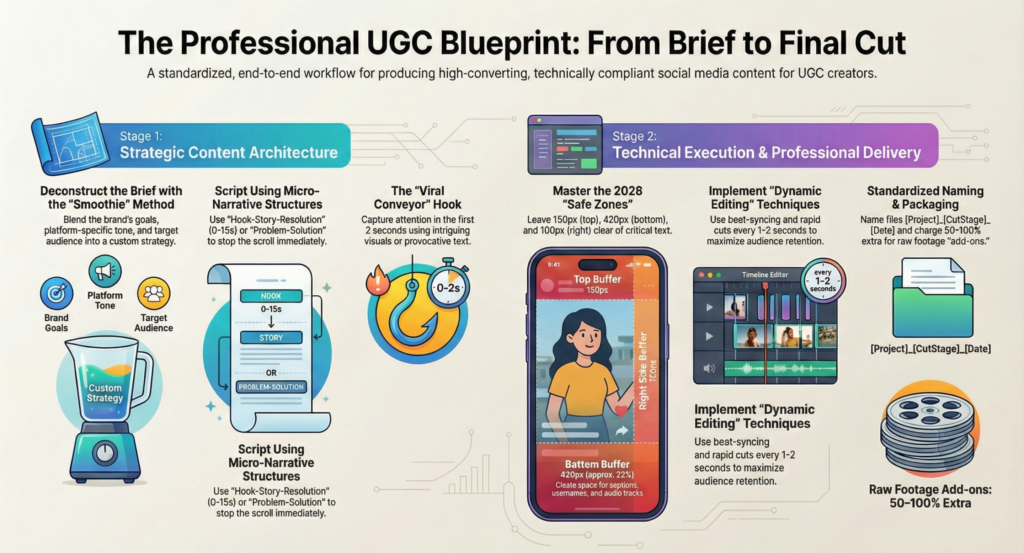
Surprising detail: a lot of UGC content is made for ads, not social feeds. So the brand might ask for raw clips (un-edited) because they want to chop it into 6 different versions later. If you’ve ever wondered why they ask for “raw + edited,” that’s why.
Also: they care about usage rights. (Translation: where and how long they can use your video.) It’s not the fun part, but it’s a real part.
Don’t confuse UGC creator with…
This is where people get cringe (or just accidentally pitch the wrong thing).
UGC creator vs influencer
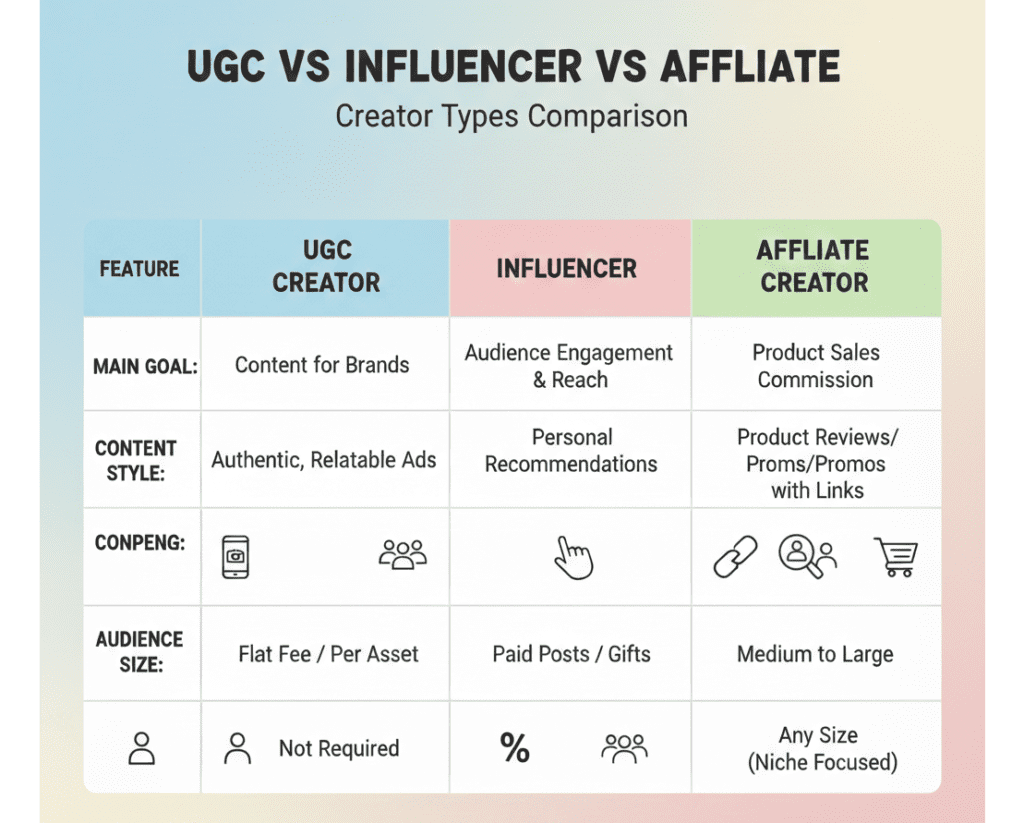
- UGC creator: “I’ll make the video. You can post it or run it as an ad.”
- Influencer: “I’ll post it to my audience.”
Concrete example: if you DM a brand “I have 2,000 followers and can post this,” and they asked for UGC, you might get ignored because you’re answering a question they didn’t ask.
UGC creator vs affiliate creator
Affiliate is about earning commission when someone buys through your link/code. UGC is typically flat pay for content. You can do both, but they’re not the same deal structure.
UGC creator vs social media manager
A social media manager plans, posts, replies, tracks analytics. A UGC creator is mainly a content supplier. One is ongoing strategy. The other is production.
If the brand wants your audience, they’ll say so. If they want your footage, that’s UGC.
Starter kit for a UGC creator (without turning your room into a studio)
You don’t need a cinematic camera. Your phone is fine. What you do need is consistency and a setup that doesn’t fight you every time you film.
Here’s the starter kit that actually matters:
1) Something that holds your phone still
If you’re trying to film hands-free demos (unboxings, skincare, “here’s how I set it up”), a simple phone tripod saves your sanity. […..]
2) Audio that doesn’t sound like you’re in a tiled bathroom
If you’re talking on camera, a small clip-on mic (or any mic setup that reduces echo) makes you sound instantly more “professional,” even if you’re in sweatpants. […..]
3) Light that doesn’t make you look haunted
If you’re filming at night or your room has weird shadows, a basic soft light helps. Not “influencer glam.” Just “I can see your face.” […..]
4) An editing app that makes the annoying parts faster
If you’re trying to batch-edit and add captions without spending your whole life nudging text boxes around, a mobile editing app with auto-captions + easy resizing helps a lot. […..]
Tiny, specific tip: look for an app where you can tap captions and move them up so they don’t sit directly on your mouth. That one UI annoyance alone will steal hours from you if you let it.
Mistakes to avoid (aka: how to not make UGC cringe)
You can be new and still be good. But these mistakes scream “I learned this from a random hustle thread.”
Mistake #1: Over-acting “authentic”
The fastest way to feel fake is trying too hard to sound real. If your script includes “I’m OBSESSED” and you’ve used the product for 2 days… people can tell. Brands can tell too.
Mistake #2: Pitching like an influencer when they asked for UGC
If the brand post says “UGC creators needed,” don’t reply with “I get 10k views.” Reply with what they’re buying: content style, turnaround, what you can deliver.
Mistake #3: Ignoring the boring stuff (file names, formats, safe zones)
Concrete example: brands will ask for “vertical 9:16” and you’ll deliver a slightly cropped 4:5 because it looked fine in your camera roll. Then they try to run it as an ad and your captions get chopped off by the button overlays. Oops.
Quick checklist that keeps you out of trouble:
- Leave space at the top and bottom (apps love slapping UI there).
- Keep your first line short and punchy.
- Export in the format they asked for.
- Name files like a grown-up (date + concept + version).
Mistake #4: Not asking about usage (politely)
You don’t need to be intense about it. Just don’t forget it exists. If they want to use your face in ads for a year, that’s different than “post it for a week.” Ask. Be normal about it.
Mistake #5: Forgetting the “why would I care?” moment
Have you ever watched a UGC-style ad and thought, “Okay but… what does it do?” That’s what happens when the video is vibes-only. Make sure the benefit lands clearly.
One last thing (and a not-weird disclosure)
A UGC creator is kind of like a brand’s stunt double: you do the on-camera work, and the brand gets the spotlight. That’s not a bad deal—just know what job you’re doing.
And yeah: sometimes the easiest way to start is to make a few sample videos for fake products in your house (your water bottle, your headphones, your favorite snack) just to practice the rhythm. No one has to know it’s practice.