

The post that says nothing (and somehow gets everyone to confess in the replies)
Vagueposting is basically the internet’s favorite magic trick: someone hints at drama, refuses to explain, and the comments turn into a full-blown detective agency. You’ve seen it. You’ve probably side-eyed it. You might’ve even… reacted to it (no judgment, I’ve been there).
It’s showing up everywhere again lately—especially on Stories and short-form feeds where the UI practically begs you to tap, reply, and “check back later.” And because the post is just unclear enough, your brain keeps trying to finish the sentence.
So yeah, vagueposting isn’t new. But it’s having a moment—because attention is a scarce resource and ambiguity is basically a magnet.
Answer Box (the quick “what is this” version)
- What it means: Vagueposting is posting a hint of a situation (usually emotional or dramatic) without details, so people ask what happened.
- When people use it: When they want support, attention, leverage, or to send a message without naming names.
- One example: “I’m done being nice to people who don’t deserve it.” (no context, no names, no follow-up)
- Don’t do this: Don’t vaguepost about something serious and then guilt people for asking. That’s how you speedrun “mute” status.
FAQ (because this is what everyone actually searches)
Is vagueposting the same as attention-seeking?
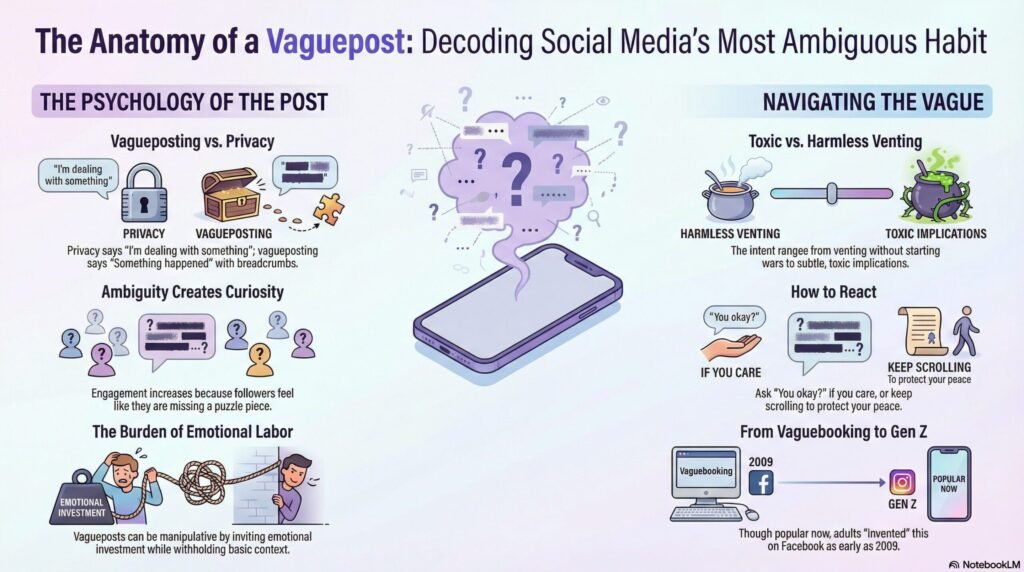
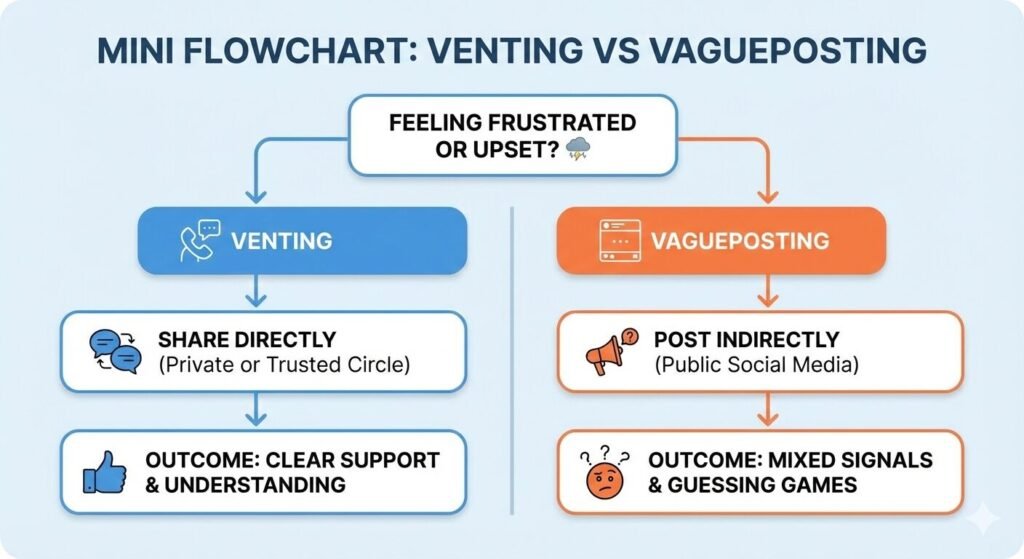
Not always. Sometimes it’s attention-seeking, sure. Sometimes it’s someone trying to vent without starting a war.
Why do vagueposts get so many comments?
Because ambiguity creates curiosity. People feel like they’re missing a puzzle piece—and commenting is the easiest way to grab it.
Is vagueposting toxic?
It can be. It can also be harmless. The vibe depends on what’s being implied and how the poster reacts.
What’s the difference between vagueposting and privacy?
Privacy is “I’m dealing with something private.” Vagueposting is “Something happened 👀” with breadcrumbs.
What do you reply to a vaguepost?
If you care: a simple “You okay?” If you don’t: keep scrolling. Your peace is priceless.
Is vagueposting a Gen Z thing?
It’s popular with Gen Z, but it’s not exclusive. Plenty of adults invented this in 2009 and never stopped.
What’s “vaguebooking”?
Same behavior, older name—people used it a lot on Facebook statuses back in the day.
Why does it feel manipulative?
Because it sometimes is. The post invites emotional labor from others while withholding basic context.
Vagueposting, explained like a human: it’s the hint, not the story
Vagueposting is when someone posts the vibe of a situation without the actual situation. It’s the emotional trailer, not the movie.
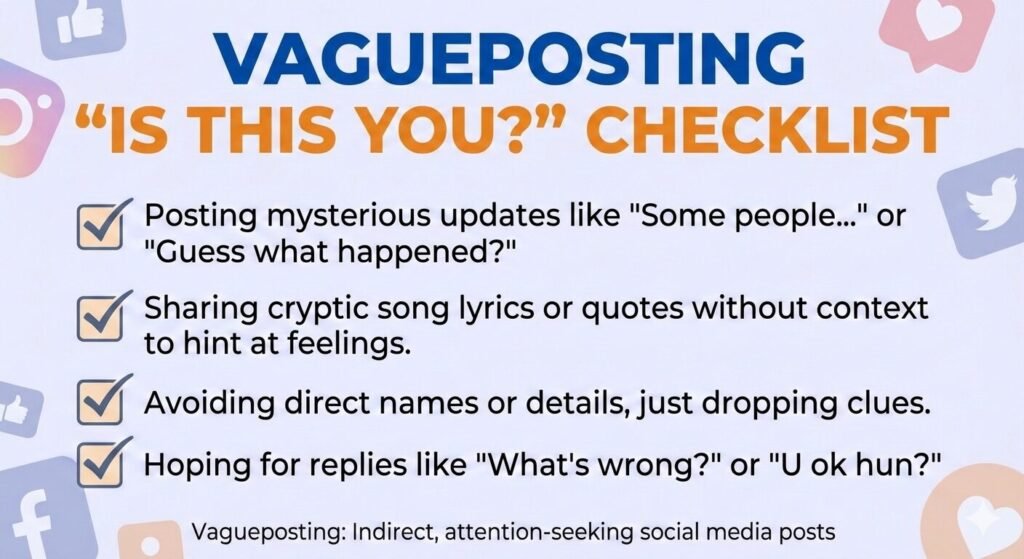
A vaguepost usually has:
- a strong feeling (“I’m so done.”)
- a mysterious “something happened” energy
- just enough detail to make people ask questions
- zero actionable context
And the replies are predictable:
“Who?” “What happened?” “Are you okay??” “DM me.” “Spill.”
Vagueposting is a post that begs for questions—then acts surprised when people ask them.
Here’s a concrete example you’ve definitely seen on a Story (because Stories are built for this):
- Black screen. White text.
- “Can’t believe some people are like this.”
- Next slide: a selfie with red eyes.
- Next slide: “I don’t wanna talk about it.”
That’s vagueposting with the full UI combo meal.
The comment-farming part (and why your brain falls for it)
Okay, quick confession: I ignored this for way too long and just thought “people are dramatic.” But the mechanics are kind of fascinating.
Vagueposts “farm” comments because:
- People want to be supportive (or nosy… or both).
- The post sets up social pressure: If you don’t ask, are you a bad friend?
- The algorithm often rewards early engagement (this is a general observation, not a guaranteed rule), so more replies can mean the post travels farther.
And platforms quietly encourage it with tiny annoyances:
- Story reply boxes sitting right there like a big red button.
- Notifications that keep the thread alive (“X commented: ‘what happened??’”).
- Comment sorting that surfaces the messiest replies first (you know what I mean).
If you’re trying to track how a vaguepost phrase spreads, a social listening dashboard helps you spot repeated wording and spikes without doomscrolling your life away. [……]
Also: a comment filter tool is underrated if you’re the one posting and you don’t want your comment section turning into a courtroom. [……]
A mini-story (because this is exactly how it happens)
You open your phone at lunch.
A friend posts: “I’m done. I swear.”
No context. No name. No follow-up.
Your group chat instantly lights up: “Is this about her ex?” “Is she okay?”
You tap their profile. Their comments are exploding.
Someone writes “spill.” Someone else writes “I knew it.”
You feel weirdly responsible, so you comment: “You good?”
They reply: “I don’t wanna talk about it.”
And somehow you’re the one left feeling awkward.
You close the app and realize you didn’t even finish eating.
That’s the emotional hangover of vagueposting.
The surprising part people miss: vagueposting is often a signal, not a secret
Here’s the detail people don’t mention enough: vagueposting isn’t always about hiding facts. It’s often about signaling a boundary while still asking for connection.
Like: “I’m going through it, but I’m not ready to share details.”
That’s different from: “Something happened 😏 and I want you to beg.”
And it’s used by more than “teen drama accounts.” You see vagueposting from:
- creators protecting relationships (they’ll hint at a breakup without naming anyone)
- coworkers avoiding HR-level detail (“some people at work…”)
- adults who grew up with Facebook and never stopped “vaguebooking” (yes, that’s a thing)
Sometimes it’s a soft-launch of a bigger post. Sometimes it’s a test balloon: “If I hint, will anyone care?”
If you’re trying to write about a situation without being messy, a caption helper can nudge you toward clarity (“private but not bait-y”) without turning you into a robot. [……]
If you want a grounded definition of the behavior, have a look at Merriam-Webster.”
Don’t confuse vagueposting with these (similar vibe, different game)
Vagueposting vs subtweeting
- Vagueposting: “People are so fake.” (no target, just a cloud of tension)
- Subtweeting: “Some influencers really need to stop buying followers.” (still not named, but the target feels sharper)
Vagueposting vs baitposting
- Vagueposting: “I’m so tired of this.”
- Baitposting: “Hot take: anyone who does X is trash.” (built to start fights on purpose)
Vagueposting vs “privacy posting”
- Privacy posting: “I’m taking a break for personal reasons.”
- Vagueposting: “If you knew what I knew…” (invites interrogation)
If you’re trying to keep up with related terms (subtweeting, baitposting, soft-launch, etc.), a trend tracker helps you see what’s rising without you having to live inside comments. [……]
Mistakes to avoid (aka how not to sound cringe)
Vagueposting can be funny. It can be relatable. It can also be… a little exhausting. Here are the biggest misfires:
- The guilt trap: Posting “I can’t talk about it” and then getting mad when people ask.
- The emergency tease: Hinting at something serious (“I don’t feel safe”) with no context. If it’s urgent, reach out directly to someone—not a comment section.
- The “you know who you are” post: That’s not mysterious, it’s passive-aggressive.
- The vaguepost flood: Three posts in one day like a serialized drama. People will mute you. Quietly. Forever.
- The tone mismatch: A vaguepost in a professional network. Please don’t. (Unless your job is literally “posting.”)
How to reply without getting sucked into the mess
If you’re the reader (and you’re not trying to become a side character in someone else’s plot), here are a few low-cringe replies that don’t escalate things:
- “You okay?” (simple, neutral)
- “I’m here if you wanna talk privately.” (moves it off-stage)
- “Sending love.” (support without interrogation)
If you’re thinking: But what if it’s about me?—honestly, that’s part of why vagueposting works. It makes everyone feel slightly implicated.
A vaguepost is an invitation. You’re allowed to decline.
And if you’re posting (no shame), try this tiny upgrade: add one line of clarity.
- “Rough day. Not ready to share details.”
That’s still private. It’s just not bait-y.
![[ CREATE IMAGE: “BETTER VAGUEPOST” TEMPLATES (3 EXAMPLES)]
Caption: place image here
Alt text: examples of what is vagueposting and safer alternatives for stories and captions](https://wtfistrending.com/wp-content/uploads/2026/02/vagueposting-templates.jpg)
Now the fun part: once you notice vagueposting, you can’t unsee it. Your feed turns into a hallway of half-whispered conversations, and you’re just walking past like, “Nope, not getting involved today.” Honestly? That’s growth.

